Archive Page 7

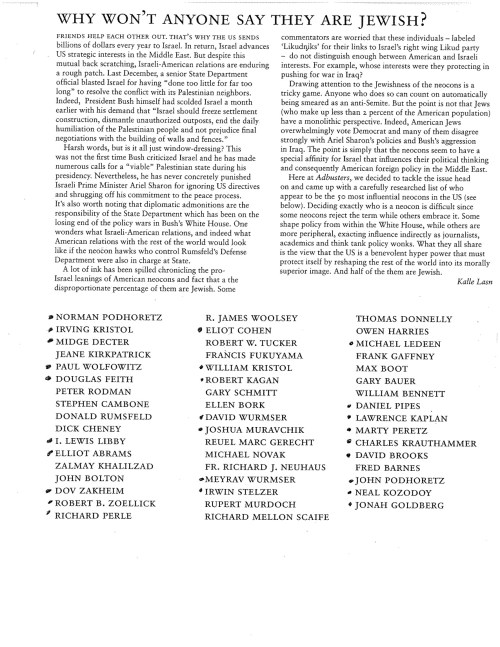
Kalle Lasn (Adbusters): “Why Won’t Anyone Say They Are Jewish?” (full image) (2004)

“Why Won’t Anyone Say They Are Jewish?”,  Kalle Lasn’s infamous Adbusters article (March/April 2004),  is often talked about. But it is curiously hard to find a copy of the actual image—especially since much of its notoriety  derives from it being a list political figures in which the Jewish ones are marked with symbols next to their names! So, with all the brew-ha-ha lately about antisemitism at Occupy Wall Street, we thought we’d pull this one out of the archives.
adbusters-jewish

We have a lot to say about antisemitism and the critique of finance capital; the failure of the left to oppose antisemitism at OWS and how this has handed openings to the right; the left’s pathetic failure in the response to these accusations, which have some validity; and the comparison between the anti-globalization and “Occupy” movements in terms of antisemitism, the critique of finance capital, and Left/Right crossover. But it will all have to wait.

Further reading about the Occupy movement, the critique of finance capital, and left/right crossover:

Spencer Sunshine,“Occupied With Conspiracies? The Occupy Movement, Populist Anti-Elitism, and the Conspiracy Theorists”

Matthew Lyons, “Rightists woo the Occupy Wall Street movement”

TPMDC, “Not Helping: David Duke Supports Occupy Wall Street”

The Liberty Lamp, “Infiltrators of the Occupy Movement.”

Michael C. Moynihan, “Busted: The Canadian magazine Adbusters sparked the Occupy Wall Street movement. It also has a weakness for Israel-bashing conspiracy theories.”

(mostly important for information at the end about Adbusters publishing Holocaust-denier Gilad Atzmon & co)

Scission,  “OCCUPY KANSAS CITY DEBATES THE “PROTOCOLS OF THE LEARNED ELDERS OF ZION”/ ARE YOU KIDDING ME”

“The bad seed of the #Occupy Movement—Occupy Tallinn”

Our American Generation, “American Neo Nazis and the Occupy Movement”

Hoosier Anti-Racist Movement (HARM), HARM Withdraws Support for Occupy Indianapolis

Mike Levine, “US Professors Travel to Iran to Discuss Occupy Wall Street Movement”

(Normally, I’d never link to FOX, but this is of interest because, while the “US professors” were leftists and marxists – one an Italian-style autonomist – Iran’s Press TV quotes a US Iman saying that the OWS 99% is “naturally against Zionism…. The monster today is global Zionism.”)

(Documents some of the antisemitic cartoons which came out in 2012 in Occupy/Anonymous circles.)

TEXT:

WHY WON’T ANYONE SAY THEY ARE JEWISH?

Friends help each other out. That’s why the US sends billions of dollars every year to Israel. In return, Israel advances US strategic interests in the Middle East. But despite this mutual back scratching, Israeli-American relations are enduring a rough patch. Last December, a senior State Department official blasted Israel for having “done too little for far too long” to resolve the conflict with its Palestinian neighbors. Indeed, President Bush himself had scolded Israel a month earlier with his demand that “Israel should freeze settlement construction, dismantle unauthorized outposts, end the daily humiliation of the Palestinian people and not prejudice final negotiations with the building of walls and fences.”

Harsh words, but is it all just window-dressing? This was not the first time Bush criticized Israel and he has made numerous calls for a “viable” Palestinian state during his presidency. Nevertheless, he has never concretely punished Israeli Prime Minister Ariel Sharon for ignoring US directives and shrugging off his commitment to the peace process. It’s also worth noting that diplomatic admonitions are the responsibility of the State Department which has been on the losing end of the policy wars in Bush’s White House. One wonders what Israeli-American relations, and indeed what American relations with the rest of the world would look like if the neocon hawks who control Rumsfeld’s Defense Department were also in charge at State.

A lot of ink has been spilled chronicling the pro-Israel leanings of American neocons and fact that a the disproportionate percentage of them are Jewish. Some commentators are worried that these individuals – labeled ‘Likudniks’ for their links to Israel’s right wing Likud party – do not distinguish enough between American and Israeli interests. For example, whose interests were they protecting in pushing for war in Iraq?

Drawing attention to the Jewishness of the neocons is a tricky game. Anyone who does so can count on automatically being smeared as an anti-Semite. But the point is not that Jews (who make up less than 2 percent of the American population) have a monolithic perspective. Indeed, American Jews overwhelmingly vote Democrat and many of them disagree strongly with Ariel Sharon’s policies and Bush’s aggression in Iraq. The point is simply that the neocons seem to have a special affinity for Israel that influences their political thinking and consequently American foreign policy in the Middle East.

Here at Adbusters, we decided to tackle the issue head on and came up with a carefully researched list of who appear to be the 50 most influential neocons in the US (see above). Deciding exactly who is a neocon is difficult since some neocons reject the term while others embrace it. Some shape policy from within the White House, while others are more peripheral, exacting influence indirectly as journalists, academics and think tank policy wonks. What they all share is the view that the US is a benevolent hyper power that must protect itself by reshaping the rest of the world into its morally superior image. And half of the them are Jewish.

Kalle Lasn


Henri Lefebvre: I am “a Marxist, of course… so that we can all be anarchists some time in the future.”

“In my first meeting with Lefebvre in 1978 I clumsily asked him, ‘Are you an anarchist?’ He responded politely, ‘No. Not now.’ ‘Well then,’ I said, ‘what are you now?’ He smiled, ‘A Marxist, of course…so that we can all be anarchists some time in the future.’”

= = =

from Edward W. Soja, Thirdspace: Journeys to Los Angeles and Other Real-And-Imagined Places (Oxford, UK & Malden, MA: Blackwell Publishers, 1996), page 33 footnote 8.

Octave Mirbeau: “anarchism has a broad back, like paper it endures anything” (1894)

“A mortal enemy of anarchism could not have done better than Emile Henry when he hurled his inexplicable bomb in the midst of peaceful anonymous people who had come into a cafe to drink a beer before going to bed…. Emile Henry says, affirms, claims that he is an anarchist. It is possible. But anarchism has a broad back, like paper it endures anything. Today it is a fashion for criminals to claim a connection with it when they have perpetrated a good crime…. Each party has its criminals and its lunatics because each party has its human beings.”

= = =

cited in James Joll, The Anarchists (NY: Grosset & Dunlap, 1964/1972), p 145-46. Joll’s footnote  says the citation is taken from Jean Maitron, Histoire du mouvement anarchiste en France (1880-1914) (Paris 1951), p. 227, and that Maitron gives his source for the quote as Le Journal, February 19, 1894.

An online version of  the second edition of Joll’s book is available here.

Max Weber: can anarchists be legal scholars? (1913)

“Admittedly, attempts have been made to set certain limits on purely ‘logical’ grounds. One of our leading jurists explained on one occasion, when he was declaring himself against the exclusion of Socialists from university posts, that even he could at least not accept an ‘anarchist’ as a teacher of law, since an anarchist would deny the validity of laws as such; and he clearly thought this argument conclusive. I am of exactly the opposite opinion. An anarchist can certainly be a good legal scholar. And if he is, then it may be precisely that Archimedean point, as it were, outside the conventions and assumptions which seem to us so self-evident, at which his objective convictions (if they are genuine) place him, which equips him to recognise, in the axioms of conventional legal theory, certain fundamental problems which escape the notice of those who take them all too easily for granted. For the most radical doubt is the father of knowledge.”

= = =

from “Value-judgments in Social Science” in Max Weber: Selections in Translation, edited by W. G. Runciman (Cambridge: Cambridge University Press, 1978), p 75. This essay was originally a paper presented in 1913 and first published in 1917.

RADICAL ARCHIVES thanks Dana Williams for finding this quotation, which we had been looking for for years!

Bookchin on Malatesta and syndicalism (1977)

Syndicalism, to be sure, has many shortcomings, but its Marxian critics were in position to point them out because they were shared by Socialist parties as well. In modeling themselves structurally on the bourgeois economy, the syndicalist unions tended to become the organisational counterparts of the very centralized apparatus they professed to oppose. By pleading the need to deal effectively with the tightly knit bourgeoisie and state machinery, reformist leaders in syndicalist unions often had little difficulty in shifting organisational control from the bottom to the top. Many older anarchists were mindful of these dangers and felt uncomfortable with syndicalist doctrines. Errico Malatesta, fearing the emergence of a bureaucracy in the new union movement, warned that “the official is to the working class a danger only comparable to that provided by the parliamentarian; both lead to corruption and from corruption to death is but a short step” (fn 3) These Anarchists saw in syndicalism a shift in focus from the commune to the trade union, from all of the oppressed to the industrial proletariat alone, from the streets to the factories, and, in emphasis at least, from insurrection to general strike.

footnote 3:  Although Malatesta was to change his attitude toward syndicalism, he accepted the movement with many reservations and never ceased to emphasize that “trade unions are, by their very nature, reformist and never revolutionary.” To this warning he added that the “revolutionary spirit must be introduced, developed and maintained by the constant activities of revolutionaries who work from within their ranks as well as from outside, but it cannot be the normal, natural definition of the Trade Union’s function.”

= = =

Murray Bookchin, The Spanish Anarchists: The Heroic Years 1868-1936 (NY, Hagerstown, SF, London: Harper Colophon Books, 1977), pp 136–37, 156.

Schiz-Flux: “War Chest Tour” (1988)

WAR CHEST TOUR

Schiz-flux held a ‘roving’ demonstration last May Day called the War Chest Tour. We sought to emphasize a total critique of the war economy by ‘hitting’ various businesses and institutions ranging from McDonald’s to the ROTC. In between these confrontations were excursions into ‘liberated zones’, areas pre-designated for the free (fore)play of radical subjectivity. Plans included a smoke-in at the Memorial Union, the burning of American, Soviet and McDonalds flags, and a May Pole dance in Peace Link park where participants would dart from the dance to the porn shops on State St. where, charged with fertile adrenalin, they would form a circle inside of which a ‘free exchange of pleasure’ could occur. Artsy props and banners were prepared for the whole occasion and over 500 flyers were distributed prior to the event asking other activist groups to plan actions on the same day.

The response was dismal. At noon we arrived with sundry props at the steps of the union and danced around while taking turns with the bullhorn exhorting students to quit work, quit school and join the ‘revolution of desire’. About 40 students gathered while huge joints of homegrown were shared with all in the vicinity. Chief of Campus Police Bozo Hansor appeared with a walkie talkie in hand to keep an eye on this small-scale insurrection as we walked around the back of the union chanting “Smash the war machine”. Once inside more joints were shared and students were invited to join  the march.

The pot must’ve spaced everyone out, though, because only 10 of us made it to the next target on the tour, the ROTC building. Also, the concept behind the Tour was not understood by the initial participants: the War Chest Tour was conceived as a fast-moving, highly-charged performance which integrated a militant anti-capitalist perspective with the liberating energy necessary to subvert the system. It was a failure because the crucial link between art, politics and pleasure is unfamiliar to most of the liberals, peaceniks and leftists that the Madison area is positively crawling with; where political asceticism and sad militancy are the prevailing models. But WATCH OUT! We may be back. If you’re interested in organizing War Chest Tour this May Day, get in contact with us!

SCHIZ-FLUX
Madison, WI

from SMILE #2 (Madison, WI), 1988,  p13.

Anarchists Against National Self-Determination, Part 1 – Joseph J. Cohen: “The Right to Self-Determination” (1951)

“THE RIGHT TO SELF-DETERMINATION”
Joseph J. Cohen

Words are bound to be the first victims in any era of great social disturbance. Their meaning and content are interpreted in various ways depending on the angle from which the person or group using them looks at the trend of general development.

Viewed in the light of the vanishing past, in which subjugated national groups were forcibly held together in the Hapsburg Empire of Austria, or in the Ottoman Empire of Turkey, the right to self determination of nations,  promulgated by President Woodrow Wilson in his historical Fourteen Points, appeared a progressive step leading to greater freedom and a better chance for the peaceful development of international relations. To the nations on the checker board of Europe at the conclusion of the first World War, the right to self determination appeared to be a just solution of the many complex problems arising out of the breaking up of the gigantic combinations of empires competing for supremacy in a world of power politics.

But when we study this problem from present-day experience and the standpoint of the new social order slowly but surely emerging from the chaos of repeated world wars, we find the solution proposed by President Wilson is in reality a stumbling block to lasting peace.

Parceling of each continent into separate hegemonies walled in by guarded boundary lines, tariffs, competing valuta and restrictions against foreigners, tends to insulate the peoples of the earth into antagonistic national sovereignties, suspicious of one another and hostile to everything cloaked in unfamiliarity.

The small, independent governments in Europe, created by the treaty of Versailles as a result of President Wilson’s formula, did not contribute to the solution of a single one of the problems confronting the western world at that time. Rather did the problems become more complicated. The racial groups of Europe are so integrated and blended that nothing short of uprooting and resettling whole populations could separate them into their component parts. Whether they like it or not, they must live together. And any encouragement toward separatism, toward self-determination, is bound to lead to more harm than good.

The baneful tendency of the right to self-determination manifested itself in the newly created states which had owed their very existence to the promulgation of the principle. No sooner had they become autonomous than they began to limit the rights of their minorities. Poland, which had suffered oppression under the Russian tsar, the German kaiser, and the Austrian emperor, immediately set out to oppress, and curtail the freedoms of, millions of Jews and Ukrainians who had lived within her borders since time immemorial. The same thing happened in Yugoslavia, Czechoslovakia, Latvia, and all the other newly created states.

The concept that a nation is endowed with the right to determine its destiny and regulate unhindered the conditions of life within its territory is based on the outworn principle of absolute right to property and on the fallacy that the rights of a nation are parallel to that of the family. Since the law recognizes the individual’s right to own and dispose of property in his own way, people are willing to grant the same right to a nation. The result is demonstrated in Australia, where 7,500,000 people occupying a territory nearly as large as the United States, by reason of their right of self-determination, do not permit people to settle there unless the latter qualify in certain limited classifications. In like manner, the 13,000,000 citizens of Canada occupying an area much larger than the United States feel justified in shutting their doors against newcomers.

Yet this is absurd. It can find no support in morals, ethics, or human usage based on any principle other than force. And any social arrangement depending solely on force must sooner or later lead to conflict and a test of arms. We are slowly coming to realize that, if we are to survive, our existence will depend on the unification of the peoples of the world and their integration into one family. One world or none is not merely a well sounding phrase, it is the sine qua non imposed upon our race by its historical development and the invention of such tools of destruction as the atom bomb and gas and bacterial warfare, which threaten to annihilate us all. Every effort to divide and separate human beings, even when based on the most idealistic of slogans, is a step backward and a hindrance to progress.

By the very nature and logic of its concept, the right to self-determination is applicable only to the basic human unit composing society, the individual. He is perfectly justified in claiming for himself freedom of action and conduct with the sole qualification of not infringing upon the rights of others, and being willing to limit his freedom by the equal right to freedom of his neighbor. Large groups of peoples, whole nations organized as sovereign states, based as they arc on compulsion and guided by raison d’etat, can hardly be expected to do justice to the term. Any recourse to the right of self-determination on their part must bring only discredit to a principle once cherished by well-meaning idealists.

= = =

from “The Right to Self-Determination” in the anthology The World Scene From The Libertarian Point of View (Chicago: Free Society Group of Chicago, 1951), pp 56–57.

The anthology’s “Notes on the Authors Herein” says Cohen “was formerly editor of the Jewish weekly Freie Arbeiter Stimme in New York City” (p 95).

RADICAL ARCHIVES NOTE: We took the basic content of this essay from a somewhat garbled, text-recognition scan of the whole anthology, which  is available here, and corrected it against the original.

G. P. Maximoff on nationalism (1951)

“Nationalism cannot be abolished; it can only be shaken off in a life of close co-operation.”

= = =

from “The State of the World” in the anthology The World Scene From The Libertarian Point of View (Chicago: Free Society Group of Chicago, 1951), p 8.

John Moore: ‘Book of Levelling’ (1995)

Book of Levelling
John Moore

And the Prime levelling, is laying low the Mountaines, and
levelling the Hills in man. But this is not all.

Abiezer Coppe, A Fiery Flying Roll

Let history be your hymn of penance,
Farm your parents and the races in the ground,
Not for pelf but for remembrance,
And make ready for the festival of ruin.

Edward Dahlberg, Cipango’s Hinder Door

Foreword

IT IS THOSE WHO ARE LEFT BEHIND, NOT THOSE WHO GO BEYOND, that are sad. The shape shifters have their own concerns. But this is a text as much concerned with life as with death. The metaphors are there for all to see. In the tradition of the I Ching and Ovid’s Metamorphosis, this is a book of change, a book of transformation, transmogrification, a book of insurrection and resurrection… a book of levelling.

JM
St. Ives, Cornwall
1 January 1995

SO THIS IS WHAT HAPPENED.

I’m going to chop it off, she said.

Why?, I said. What for?

I want to, she said. And anyway you don’t need it anymore.

That’s true, I said. But what will you do with it?

There are all kinds of things I can do with it, she said. You’ll see. Bring it here.

With this she motioned me toward an old, unvarnished kitchen table. The surface was grainy. As I was naked already, I placed my cock flat on the surface, pressing my groin tightly to the edge. It was just the right height. My cock laid there, flaccid and shrivelled. The tabletop was cold.

Continue reading ‘John Moore: ‘Book of Levelling’ (1995)’

Sam Dolgoff: “Modern Technology and Anarchism” (1986)

“Modern Technology and Anarchism”
Sam Dolgoff

In their polemics with the Marxists the anarchists argued that the state subjects the economy to its own ends. An economic system once viewed as the prerequisite for the realization of socialism now serves to reinforce the domination of the ruling classes. The very technology that could now open new roads to freedom has also armed states with unimaginably frightful weapons for the extinction of all life on this planet.

Only the social revolution can overcome the obstacles to the introduction of the free society. Yet the movement for emancipation is threatened by the far more formidable political, economic and social power and brain-washing techniques of the ruling classes. To forge a revolutionary movement, inspired by anarchist ideas is the great task to which we must dedicate ourselves.

To make the revolution we must stimulate the revolutionary spirit and the confidence of the people that their revolution will at last reshape the world nearer our aspirations. Revolutions are stirred by the conviction that our ideals can and will be realized. A big step in this direction is to document the extent to which the liberating potential of modern technology constitutes a realistic, practical alternative to the monopoly and abuse of power.  This is not meant to imply that anarchism will miraculously heal all the ills inflicting the body social. Anarchism is a twentieth century guide to action based on realistic conceptions of social reconstruction.

Anarchism is not a mere fantasy. Its fundamental constructive principle – – mutual aid – – is based on the indisputable fact that society is a vast interlocking network of cooperative labor whose very existence depends upon its internal cohesion. What is indispensable is emancipation from authoritarian institutions over society and authoritarianism within the people’s associations – – themselves and miniature states.

Peter Kropotkin, who formulated the sociology of anarchism, wrote that “Anarchism is not a utopia. The anarchists build their previsions of the future society upon the observation of life at the present time…” If we want to build the new society the materials are here.

DECENTRALIZATION

When Kropotkin wrote in 1899, his classic Fields, Factories and Workshops to demonstrate the feasibility of decentralizing industry to achieve a greater balance and integration between rural and urban living, his ideas were dismissed by many as premature. However, it is no longer disputed that the problem of making the immense benefits of modern industry available to even the smallest communities has largely been solved by modern technology. Even bourgeois economists, sociologists and administrators like Peter Drucker, John Kenneth Galbraith, Gunnar Myrdal, Daniel Bell and others now favor a large measure of decentralization no because they have suddenly become anarchists, but primarily because technology has rendered anarchistic forms of organization “operational necessities” – – a more efficient devise to enlist the cooperation of the masses in their own enslavement.

Continue reading ‘Sam Dolgoff: “Modern Technology and Anarchism” (1986)’