Archive Page 3

R.J. Lambrose – “Chomsky Unplugged” (1996)

As recently as the 1980s, the farthest an academic could make it in the world of popular culture would have been a brief appearance on the Today show to flog a new book. But cultural studies has changed all that. Now that professors have been churning out books and articles about rap, Elvis, and Madonna, the bemused performers are beginning to scratch the occasional academic back, or better, blurb the occasional academic book. Consider, for example, the quotes on the back cover of Michael Eric Dyson’s recent Making Malcolm, from Oxford University Press. In addition to the more predictable endorsements from Cornel West, Angela Davis, Jesse Jackson, and Carol Moseley-Braun, we also hear from Chuck D of Public Enemy: “With the situation getting more hectic, the real troopers come far and few. And with misinformation spreading, it is a necessity to follow Michael Eric Dyson. He’s a bad brother. Check out his new book Making Malcolm by all means.”R-468022-1118177447.jpg
The rappers’ reverence for cultural studies scholars hardly comes as a big surprise; Dyson, after all, testified on behalf of rap music at a congressional hearing in 1994. More startling, however, was the recent report that MIT linguistics professor Noam Chomsky is a major fave with top rock musicians. Rock & Rap Confidential magazine describes Chomsky—the embodiment, we had always thought, of old-fashioned leftist rectitude—as “a quote machine with all the rockers.” Chomsky’s anarchism has also made him a hero to punkers: Bad Religion put an entire Chomsky lecture on the B-side of one of their seven inch singles. And Maximum Rock’n’Roll, a leading fanzine with a circulation of 10,000, reprints Chomsky’s speeches for its Generation X readership. Other tributes abound: In 1994 an Austin-based band called The Horsies did a single they titled “Noam Chomsky.” U2’s Bono has called Chomsky a “rebel without a pause” and “the Elvis of academia.” And Peter Garrett, shaven-headed lead singer for the Australian rockers Midnight Oil, launched into a song called “My Country” at a Boston-area concert by invoking the following trinity: “Thoreau, Noam Chomsky, and…the Hulk!”

The Chomsky connection appears all the more remarkable when one learns more about the linguist’s own rather unusual relationship to mass culture. Because Chomsky can speed-read any document, he apparently grows impatient with the slowness of the fast-forward mode on a VCR. A friend who sought out a Chomsky blurb for a radical video was told by a go-between that the professor might consider wiring an endorsement after he read the script, but he refuses to screen films. He even declined to watch Manufacturing Consent, the documentary about him, and instead insisted the producers give him a transcript. (Unfortunately, he’ll never see Pulp Diction, Quentin Tarantino’s soon-to-be-released homage to Chomsky’s 1965 best-seller, Aspects of the Theory of Syntax.)

All of this raises the intriguing question of whether Chomsky has vetted the rock encomiums to his work. If he has, we would guess that this means that there are now two people who actually read rock lyrics: Noam Chomsky and Tipper Gore.

= = =

Lingua Franca: The Review of Academic Life, May/June 1996, page 10.
“Billy Graham Invites Unabomber To Sacramento Crusade” (1995)

Associated Press, October 17, 1995

(Sacramento, California) — Evangelist Billy Graham is inviting the elusive Unabomber to his Christian crusade beginning tomorrow in Sacramento, California.

Graham says he believes violent crime is part of increasing evil in society. But he says spirituality and goodness also are on the increase. The evangelist said yesterday he believes people should pray for the bomber and that he hopes the man will seek salvation.

Law enforcement investigators believe the terrorist, responsible for a string of sometimes deadly bombings, may live in the Sacramento area.

Murray Bookchin, in praise of hippie “Youth Culture” and “life-style” (1970)

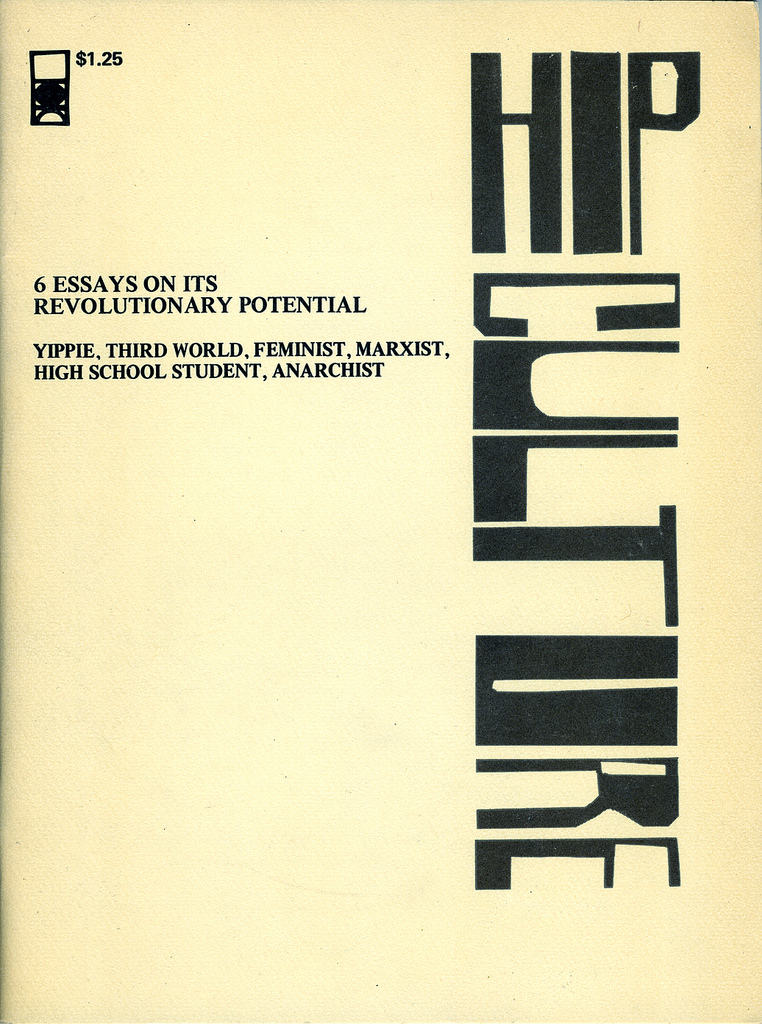
hip cultureWe must break away from the traditional Marxian outlook, with its limited interpretation of the class struggle, of the motive forces for revolution, and of the revolutionary process, to understand the revolutionary implications of the Youth Culture. …

Nourished by the relative abundance produced by a new, potentially revolutionary technology, young people began to develop a post-scarcity outlook—however confused, rudimentary, and intuitive its forms—that has been slowly eroding the ages-old psychic complicity between oppressor and oppressed—a complicity that had made hierarchy, domination, patriarchy, renunciation, and guilt a condition of the human spirit, not only the institutional and psychological instruments of class-rule and the state. It is difficult to convey what a historic breach this emerging Youth Culture produced in the social desert that was once America. …

The explosion of the Youth Culture shattered this decade-long edifice and its mythology [i.e., the social conformity of the 1950s—RA] to their very foundations and, almost alone, is responsible for the massive alienation that permeates American youth today. For the first time in the history of this country, every verity not only of bourgeois society but of hierarchical society as a whole is now in question. Mere critique of the kind so endearing to the orthodox Marxists might have produced nothing more than a sense of cynical engagement, so similar to Salinger’s young hero in “Catcher in the Rye.” But the Youth Culture went further—into the realm of positive, utopian alternatives. In its demands for tribalism, free sexuality, community, mutual aid, ecstatic experience, and a balanced ecology, the Youth Culture prefigures, however inchoately, a joyous communist and classless society, freed of the trammels of hierarchy and domination, a society that would transcend the historic splits between town and country, individual and society, and mind and body. Drawing from early rock-and-roll music, from the beat movement, the civil rights struggles, the peace movement, and even from the naturalism of neo-Taoist and neo-Buddhist cults (however unsavory they may be to the “Left”), the Youth Culture has pieced together a life-style that is aimed at the internal system of domination that hierarchical society so viciously uses to bring the individual into partnership with his/her own enslavement. …

The Youth Culture has spread from the Haight-Eastside axis into the most remote towns of the United States, areas that no radical movement in the past could have hoped to colonize, disrupting all the time-honored ties, institutions, and values of these communities. Owing to its increasing influence on working class youth, the culture has now begun to rework the labor reserves of bourgeois society itself—the reservoirs from which it recruits its industrial proletariat and soldiers—until recently, perhaps the most intractable element to radical ideas and values.

= = =

Murray Bookchin, “The Youth Culture: An Anarcho-Communist View,” in Hip Culture: 6 Essays on Its Revolutionary Potential; Yippie, Third World, Feminist, Marxist, High School Student, Anarchist (New York: Times Change Press, 1970), 54, 55, 58–59, 60.

RADICAL ARCHIVES NOTE: Bookchin became quite well-known late in life for his scathing attacks on a bogeyman he called “lifestylism”—a ridiculous strawman composed of wildly disparate parts of the early 1990s anarchist milieu, united mostly by the fact that he didn’t like them. But Bookchin’s early, favorable view of the 1960s counterculture made a coherent argument in favor of its potential, and, if it had a failure, it was that it was too uncritical in its assessment.

When Taco Bell Promoted Fanzines (1993)

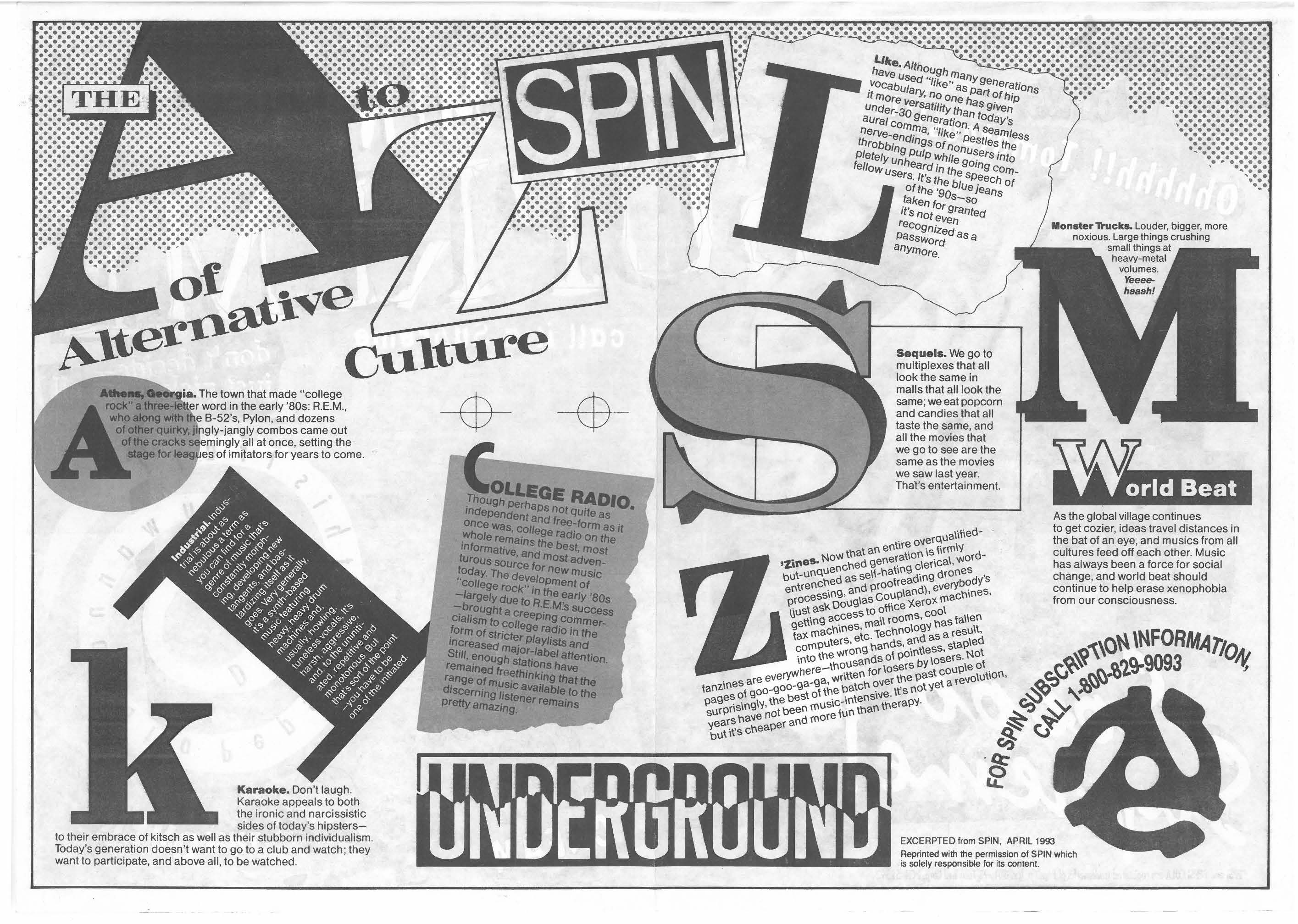
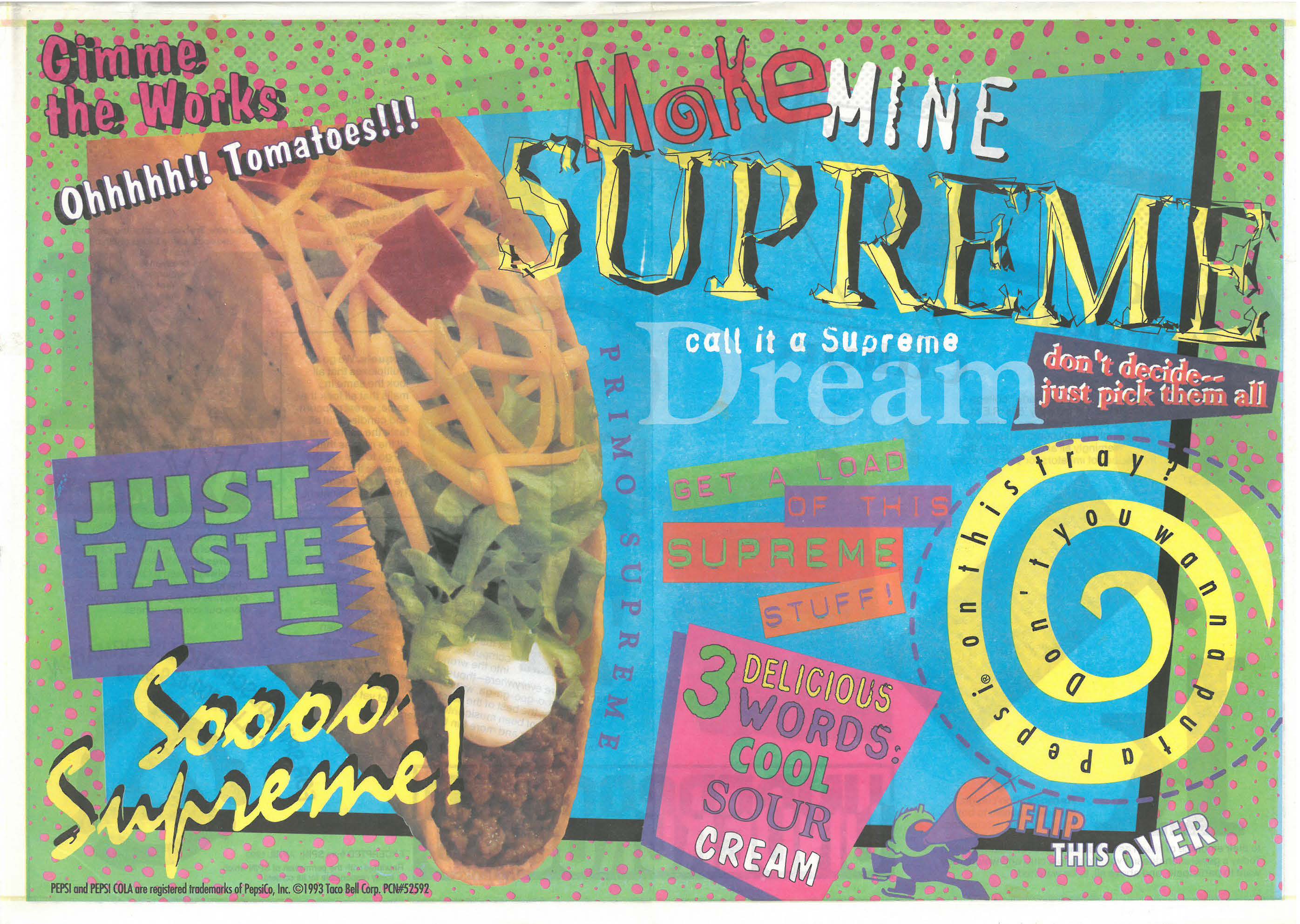
I’m not sure if it’s easier or harder to believe today, but in 1993 the grunge-driven corporate cooptation of the 1980s underground music scene – now watered down and repackaged as “alternative” – had reached such a level that even fast food was getting into it. Taco Bell issued a paper placemat, apparently based on a piece from Spin, so their customers could familiarize themselves with important aspects of the “alternative” culture, including fanzines.

‘Zines. Now that an entire overqualified-but-unquenched generation is firmly entrenched as self-hating clerical, word-processing, and proofreading drones (just ask Douglas Coupland), everybody’s getting access to office Xerox machines, fax machines, mail rooms, cool computers, etc. Technology has fallen into the wrong hands, and as a result, fanzines are everywhere – thousands of pointless, stapled pages of goo-goo-ga, written for losers by losers. Nor surprisingly, the best of the batch over the past couple years have not been music-intensive. It’s not yet a revolution, but it’s cheaper and more fun than therapy.

It was strange days, indeed.

Taco Bell - back

Taco Bell - front

Ron Asheton on New Order and Rock’n’Roll Nazi Chic

RON ASHETON [ex-Stooges guitarist, 1975]: I’d made contact in L.A. with Dennis Thompson of the MC5 and we put New Order together. I found a backer and guys started filtering in and we found a place to practice. The downside was the trend of music was changing so dramatically that we got caught in the middle of a shit storm. It was disco time, and people weren’t going for the hard-rock shit anymore, so it was like, “Uh-oh, screwed again.” Plus, we’d play gigs in front of my big swastika flag. I wasn’t a Nazi, the flag was just part of my collection . . . I had Jewish girlfriends and black buddies. It had nothing to do with promoting Nazism or condoning it. I just enjoyed flash uniforms. But other people freaked–they were like, “It’s fascist.” New Order didn’t mean to put out a Nazi vibe at all. I knew it was probably a bad idea … how not to get a record deal in an industry run by Jewish people. “New Order? Let’s sign ’em up right now.”

= = =

from Marc Spitz & Brendan Mullen, We Got the Neutron Bomb: The Untold Story of L.A. Punk (New York: Three Rivers Press, 2001), pp. 30-31.

RADICAL ARCHIVES NOTE: Nazi chic probably has a long history in rock’n’roll, especially via biker culture, but this is the first description of band I’ve run across that seemed to have intentionally presented themselves as a Nazi rock group, even if it was cartoonish play. [later RA note: I have since found at least one earlier band.] There is no reason to think that New Order was meant in an ideological way; Asheton’s Nazi fetish is well-known. But the circulation of Nazi imagery and themes in rock’n’roll had gone on at least for a good chunk of the 1970s — so when actual, ideologically neo-Nazi punk bands emerged at the end of the decade, was it really a surprise?

Not one to let sleeping dogs lie, after New Order, Asheton played in a band called New Race.

Interview with Nervous Gender (2015)

Formed in 1978, Nervous Gender was a pioneering queer synth-punk band from Los Angeles. They’re easily identifiable by their aggressive punk sound played on all synths, as well as transgressive sexual subject matter and visual style–the latter which presaged the goth scene. While many post-punk and new wave bands adopted synths soon after, almost none continued in the punk vein that Nervous Gender and the Screamers had originally explored.

The band went through a number of permutations before breaking up after the death of founding member Gerardo Velazquez in 1992. In 2007 the band reformed with old and new members, and I caught up with them in December 2014 after their first-ever show in New York City. We talked about the evolution of the band over the years, as well as former members like Phranc; their relation to the LA “art-damaged” scene as well as to No Wave, industrial, and goth/death rock; the question of fascism, homophobia, and what it meant to be queer in the ’70s LA punk scene; and their mention on the 700 Club.

They have recently remixed their 1981 studio album, and released three live recordings, documenting  different periods of the band, including a 1979 show with Phranc and a 1986 show with Wall of Voodoo members. These can be purchased via their website http://nervousgender.com.

DISCOGRAPHY

Live at Target (Subterranean Records, 1980), compilation with Factrix, uns, and Flipper
Music from Hell (Subterranean Records, 1981)
Live at the Hong Kong Cafe 1979 (Nervous Gender Archives, 2006)
Live at the Whiskey A Go-Go 1980 (Nervous Gender Archives, 2006)
Live at the Roxy 1986 (Nervous Gender Archives, 2006)
Music From Hell, 2009 Remixed / Remastered (Nervous Gender Archives, 2009)
“Gestalt” / “Green Tile Floors” (Test Tube Records, 2011), 7″

This is an edited version of a December 7, 2014 interview at the Box Hotel in Greenpoint, Brooklyn.

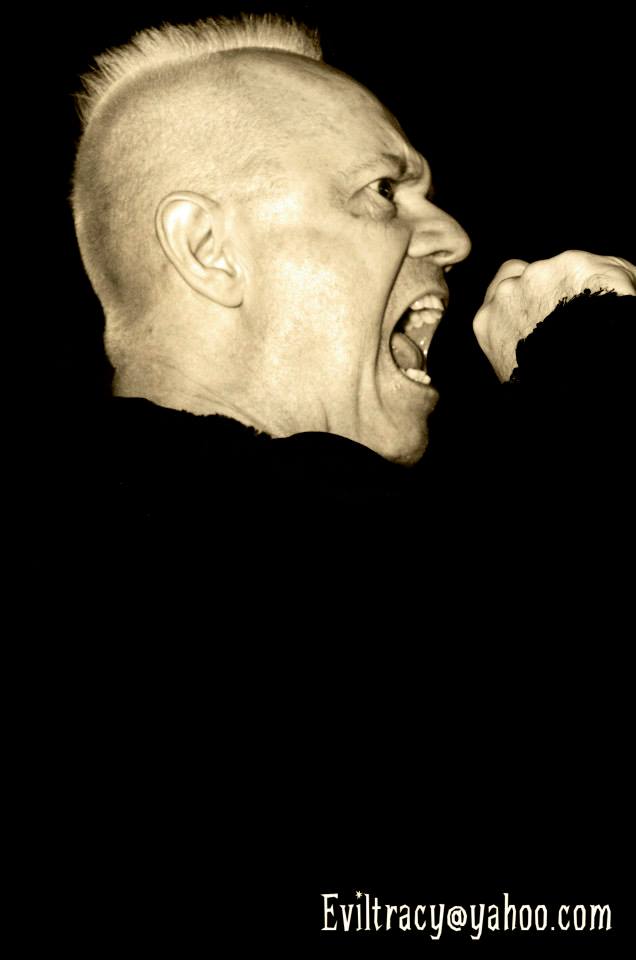
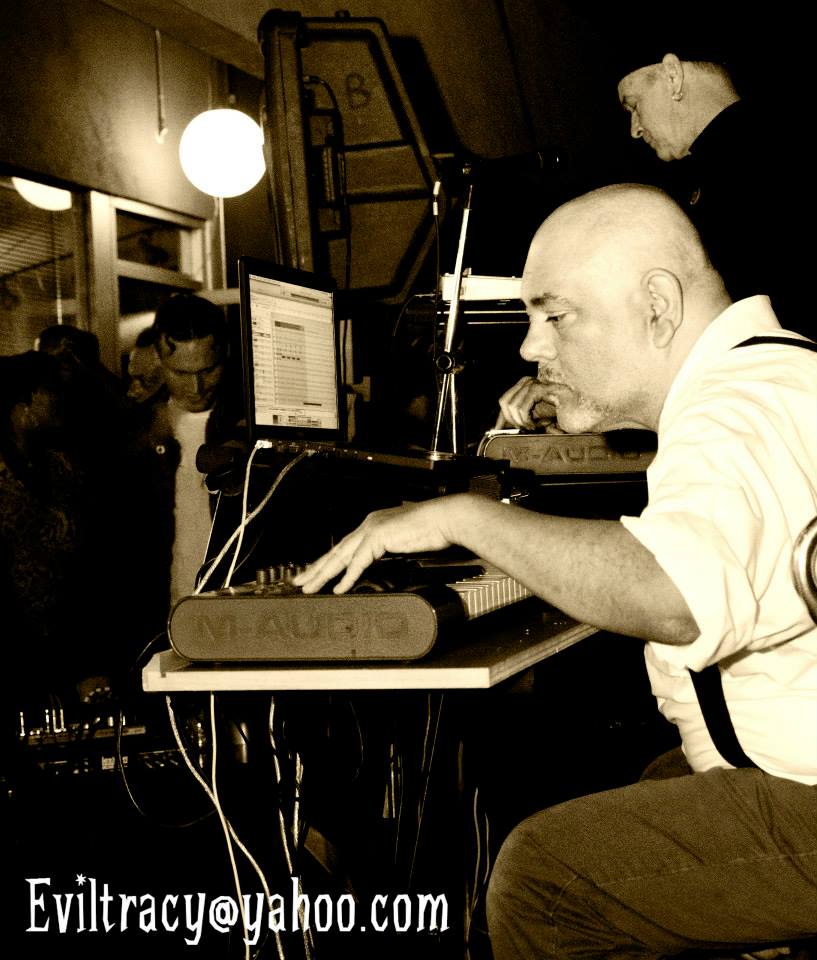
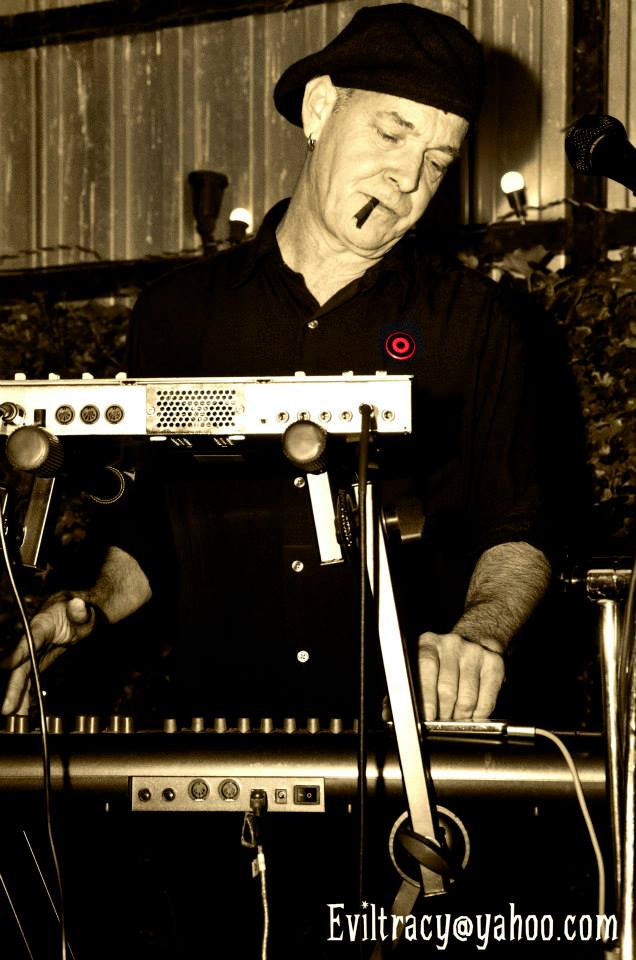
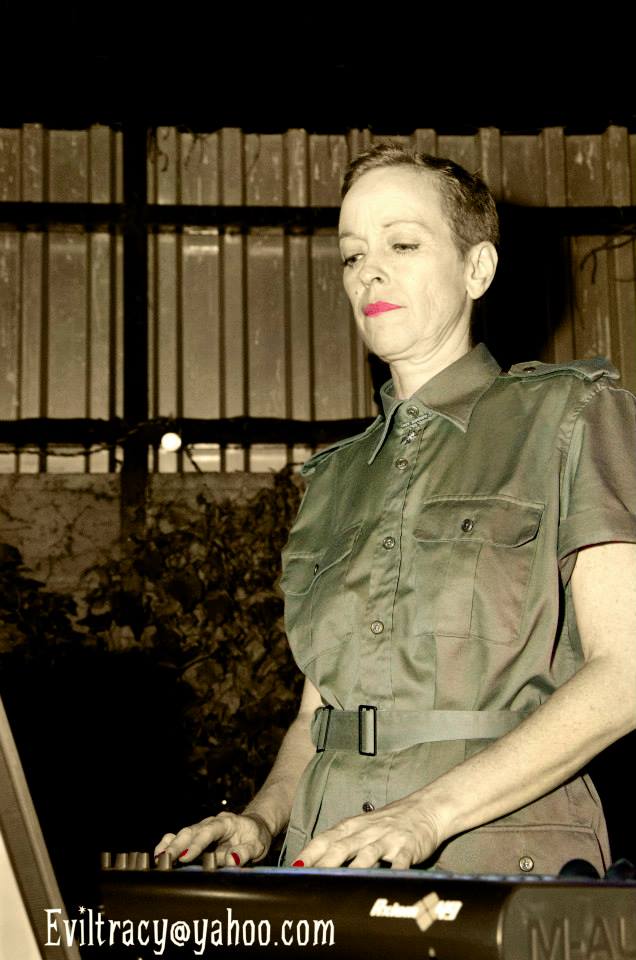
Band photos are from Evil Tracey. Please contact her for reprint permission: eviltracey at yahoo dot com.

http://www.youtube.com/watch?v=pWYKeN_wBK0

SPENCER SUNSHINE: So I’m in Brooklyn with Nervous Gender. What’s the name of everyone in the band today and what’s everyone’s history with the band?

Edward Stapleton

Edward Stapleton

EDWARD STAPLETON: Me and Michael Ochoa are the original members. Joe and Tammy were friends from the very beginning, but they weren’t in the band. [Turns to Joe and Michael] How many years ago did you guys start it up again?

JOE ZINNATO: ‘89? I’ve been in the band since ’89, Tammy’s been in the band about…

TAMMY FRASER: I was just the manager and then I became the fill in…

JOE: Like two years ago?

Michael Ochoa

Michael Ochoa

MICHAEL OCHOA: I had a stroke four years ago.

TAMMY: Was it four?

MICHAEL: Yeah.

JOE: So she was in the band for four years

MICHAEL: So I wasn’t able to play, and they had a show, so they got Tammy sucked in.

Joe Zinnato

Joe Zinnato

JOE: Yeah and Tammy actually knows how to play keyboards…

MICHAEL: …which we don’t…

JOE: …and read music, so it was kinda no-brainer. We had a show lined up, so she became our pinch hitter.

SPENCER: So the band has an odd history. The original form was between ‘79 to ‘89, and then Gerardo—this is what I read online—had a trio from ‘90 to ‘92.

Tammy Fraser

Tammy Fraser

TAMMY: It was Joe, Michael and Gerardo.

JOE: The original lineup was from like ‘78 to ‘79. These two, and Phranc…

MICHAEL: …the lesbian folk-singer…

JOE: …and Gerardo. And Phranc left, and there was also a drummer, Don Bolles. That was the original lineup, which lasted about a year. And then after that, people rotated in and out. It was never—except for the first year—it was never a consistent lineup.

SPENCER: So that was one of my questions, there was so many members of the band, like Paul Roesseler, most of Wall of Voodoo, and an eight-and-a-half year-old boy named Sven, sometimes I wonder about bands—was it more like an arts collective then if people are just rotating in and out, or did it have the consistency?

Continue reading ‘Interview with Nervous Gender (2015)’

Chumbawamba, the Pentagon, and the Bombing of Iraq (1998)

“Martial Music”

The tentative U.S. military campaign against Iraq already has its own unofficial theme song. Last week, senior Pentagon staffers privately circulated an audio-file E-mail with a pro-war parody of “Tubthumping,” a hit from the British band Chumbawamba. The blend of drinking song and rugby cheer (“I get knocked down, but I get up again”) has been transformed into a jingoistic war cry: “Let’s hunt him down and shoot him in the head, / Let’s beat the crap outta Saddam…. And if he won’t let us look for all his nerve gas / The U.S. Army is gonna kick him in the a–.” An ethereal voice chimes in with “Don’t screw with the U.S.A.”

= = =

U.S. News and World Report, March 2, 1998

Deleuze: Nietzsche is “the dawn of counterculture” (1973)

“Probably most of us fix the dawn of our modern culture in the trinity Nietzsche-Freud-Marx. And it is of little consequence that the world was unprepared for them in advance.  Now, Marx and Freud, perhaps, do represent the dawn of our culture, but Nietzsche is something entirely different: the dawn of counterculture.”

= = =

Gilles Deleuze, “Nomad Thought,” in David B. Allison, ed., The New Nietzsche: Contemporary Styles of Interpretation (New York: Delta/Dell, 1977), page 142. Translated from the French by Allison; original is “Pensée nomade,” in Nietzsche aujourd’hui (Paris: Union Générale d’Editions, 1973).

Ian Bone: How Crass’s Penny Rimbaud Saved EP Thompson from Being Decapitated by Class War

[Ian Bone describes how Class War is being confrontational towards speakers at a CND rally in Hyde Park in October, 1983]

Next up is silver-mained EP Thompson, author of The Making of the English Working Class, a book we all hold in great esteem and whose mob traditions we even feel we’re part of. But no matter—[Class War’s] Doc Whelan’s limited patience threshold has well and truly been breached. He has a glass cider flagon which he was reserving for Kinnockio [Neil Kinnock] but decided ‘some fucking professor’ will do just as well for a target. He has a sighting heave with a piece of concrete which whistles past EP Thompson’s locks on a still rising trajectory. He starts to spin like a hammer thrower with the flagon as the hammer. EP Thompson’s health is seriously at risk, and I’m doing fuck all to protect one of my favorite writers from decapitation. Thankfully, others aren’t so paralyzed. A firm arm grabs Doc’s wrista move usually likely to incur the dreaded Whelan forehead crunching down on the bridge of your nose. Doc recognizes the owner of the arm as Penny Rimbaud. ‘He’s not the one that deserves that,’ says Penny, ‘save it for later.’ Wise words and Doc concurs.

= = =

Ian Bone, Bash the Rich: True-Life Confessions of an Anarchist in the UK (Bath, UK: Tangent Books, 2006), pp 139-40.

Dorothy Healey on Angela Davis and Eastern European political prisoners

The Angela Davis defense campaign had been the biggest [U.S. Communist] Party-initiated movement of the entire decade, and it was the one occasion on which the Party was really attuned to the political mood of the younger Left. It had a big effect on the Party and brought in a number of young recruits. Indeed, whatever political credibility the Party had to draw upon from the early 1970s was largely a product of that campaign. Certainly nothing else it has done since compares with the importance of Angela’s defense campaign in terms of image and the ability to interest outsiders. Angela Davis, not Gus Hall, has been the most attractive public face the Party has had to offer. But one of the sadder aspects of the whole episode was the impact it had on Angela herself. She felt that it was the Party and the Soviet Union which saved her life. She became unwilling to consider any criticisms of those she regarded as her saviors. When she was released from prison, the first thing she did was embark upon a tour of the Soviet Union, eastern Europe, and Cuba to thank them for supporting her during the trial.

Miss Charlene Mitchell, a close friend of Angela Davis, the black militant, said today that Miss Davis would not be responding to the appeal for help from Mr. Jiri Pelikan, one of the leading figures in the “Prague Spring” now living in exile.

Miss Davis, she said, did not think that people should leave socialist countries to return to the capitalist system. This was a retrograde step, and even if such people said they were communists they were still acting in opposition to the “socialist system,” objectively speaking.

In his appeal, which was published in The Times today, Mr. Pelikan asked Miss Davis to call for the release of political prisoners in Eastern Europe as well as in capitalist countries.

Miss Mitchell, who said she was acting as a spokesperson for Miss Davis, took the line that people in Eastern Europe got into difficulties and ended in jail only if they were undermining the government. ­­­ —(Manchester) Guardian, July 29, 1972.

While Angela was on her tour and not always available to western reporters, Charlene and other Communist leaders sometimes put words in her mouth, denying that there was any political repression within the Soviet bloc. Not that Angela was willing to do anything to challenge that view. In fact, within the next few years, she accommodated herself to the stalest clichés in the Party’s outlook. She remains to the present an important public figure, able to attract larger audiences than any other Party leader. But rarely if ever in her speeches and writings today will you see evidence of the kind of fresh thinking of which she was once capable. Whether she is capable of breaking free from the Party orthodoxy is a question still to be answered.

& & &

Dorothy Ray Healey and Maurice Isserman, California Red: A Life in the American Communist Party (Urbana and Chicago: University of Illinois Press, 1990/1993), pages 220­–21.