Archive Page 12

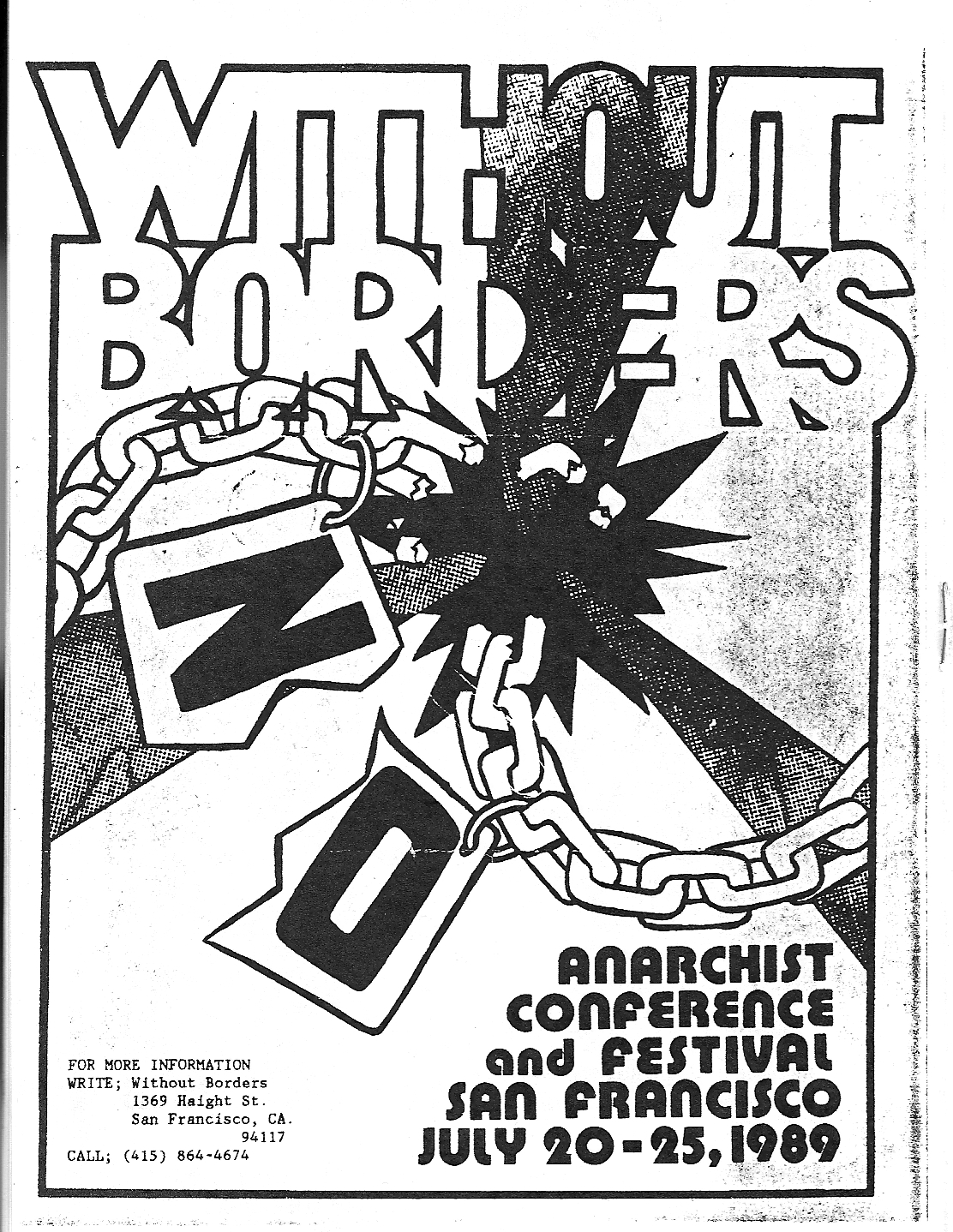
‘Without Borders’ SF anarchist gathering, flyer (1989)

‘Without Borders’ was the last of  the 1980s anarchist conferences / gatherings / festivals that were held in the US and Canada. These included Chicago (1986), Minneapolis (1987) and Toronto (1988). Thousands of people attended the San Francisco event. Among other things, the Love & Rage project emerged from the gatherings. This specific image is scanned from the zine A New Iron Column. (Click on image to enlarge.)

.

Skirda on “Jewish capital” and the Dreyfus Affair

In fact, the period was profoundly marked by that [Dreyfus] Affair: it gave rise to a confused turmoil in which a revolutionary cat would have had great difficulty identifying her kittens! The root cause of it all was the unjust conviction of a captain, (a millionaire and son of a millionaire in the francs of the day) on account of his Jewish faith. Many anarchists let themselves be dragged into this questionable episode; Sébastien Faure even set up a daily newspaper with the backing of Jewish capital, and good comrades wrote for it. It is questionable whether libertarians seized upon the issue the better to attack and discredit the army, the very army whose commanders had waded deep in the blood of the Communards. This, it was a sort of revenge from beyond the grave, albeit in a very roundabout fashion. But let us move on.

= = =

from Alexandre Skirda, Facing the Enemy: A History of Anarchist Organization from Proudhon to May 1968, translated Paul Sharkey. (Edinburgh & Oakland: AK Press, 2002), p 70 footnote 5.

Juan García Oliver: “revolutionary syndicalism serves the proletariat, whereas anarchism is one brand of humanism”

Q. Given how your life developed, that was a significant discovery.

A. Yes, especially as it was during that [[waiters’]] strike that with other comrades from the trade, young men, we had set up an anarchist group that affiliated itself to the Barcelona Local Federation of Anarchist Groups. That federation bore the name “Bandera Negra” [Black Flag], borrowed from the title of the newspaper it published. In Barcelona there was another federation of groups as well, the “Bandera Roja” [Red Flag]. “Bandera Negra” was, let us say, a classic receptacle for anarchist ideas and was against revolutionary syndicalism. “Bandera Roja” claimed to be close to revolutionary syndicalism but it was, all in all, syndicalism pure and simple, with all that that implies… I imagine we’ll be returning to this theme as our interview proceeds.

Continue reading ‘Juan García Oliver: “revolutionary syndicalism serves the proletariat, whereas anarchism is one brand of humanism”’

Greg Kaza: “Hitler’s Klanarchist” (1987)

“Hitler’s Klanarchist”

The rhetoric is anti-state. “They pictured me as a threat to the nation,” Robert Miles told Metropolitan Detroit magazine (June 1987), referring to the FBI. “But let me tell you the kind of threat I am: I publish a newsletter. I don’t harm or threaten anyone. Granted, I don’t like the government – I’m an anarchist, in fact. But these Ollie Norths see sedition in the five cows I have out in my pasture.”

On April 24, Miles and nine other white supremacists were indicted by a Fort Smith, Arkansas federal grand jury for sedition, a rarely-used charge not employed since World War II. Miles and the others are charged with conspiring between mid-1983 and early 1985 to overthrow the U.S. government and establish an Aryan Nation.

The prosecutions underscore what has been a resurgence of violence by the racial right in this country. During the last three years, Ku Klux Klansmen and neo-Nazis have committed more violence than they had in the preceding 20 years. The government holds Miles, the nation’s top white supremacist, responsible.

Continue reading ‘Greg Kaza: “Hitler’s Klanarchist” (1987)’

James Horrox on anarchism and early kibbutzim

The Zionism of the early kibbutz communards had never imagined a national revival taking the form of a state-building enterprise. For them, the Balfour Declaration in 1917, promising a “national home” for the Jews, meant an opportunity to establish a completely new form of society and a chance to put their dreams and visions into practice. Collective settlement was not seen simply as the most efficient way of colonizing the land in order to create a Jewish state and install a market-capitalist economy, as some have since argued. Though the later centrality of the movement to the creation and defence of Israel is clear, the notion that the pioneers resorted to collectivism simply in order to create suitable conditions for the institution of that state is largely a myth. Even the founders of Degania were strictly opposed to the notions of government and state, and by the time the Third Aliya groups arrived, the idea of building a stateless society on the back of the new social model they had created was one that was widely embraced. The idea held in common by many of the groups arriving in Palestine during the 1920s was to transform the Yishuv into a stateless commonwealth of autonomous communities that would include few, if any, non-collective alternatives.

= = =

from James Horrox, A Living Revolution: Anarchism in the Kibbutz Movement (Oakland, CA & Edinburgh: AK Press, 2009), pp 57–58.

Claude Lefort: the “abolition of power” as totalitarian

Whoever dreams of an abolition of power secretly cherishes the reference to the One and the reference to the Same: he imagines a society which would accords spontaneously with itself, a multiplicity of activities which would be transparent to one another and which would unfold in a homogeneous time and space, a way of producing, living together, communicating, associating, thinking, feeling, teaching which would express a single way of being. Now what is that point of view on everything and everybody, that loving grip of the good society, if not an equivalent of the phantasy of omnipotence that the actual exercise of power tends to produce? What is the imaginary realm of autonomy, if not a realm governed by a despotic thought?

= = =

from Claude Lefort, “Politics and Human Rights” in The Political Forms of Modern Society: Bureaucracy, Democracy, Totalitarianism, edited by John B. Thompson. (Cambridge, MA: MIT Press, 1986), p 270.

Romanian Secret Police on Anarchist Fanzines

[From the You Can’t Make This Shit Up department…]

When [the anarchists] were involved with Young Friends of Nature, the NGO I planted trees with, the [Romanian] authorities did not seem to mind their presence. But recently, the secret police took notice. They authored a series of articles for the country’s tabloids about the anarchist threat. Mani leaves for a moment and returns with a newspaper.

“It says here we are Satanists. And down here, it says we all practice bestiality and necrophilia. And you know, fanzines?” We all nod – in America, we usually just call them zines. “Well, they almost got this right. It says here that anarchists make home-made magazines, except it then says the fanzines are child pornography, sold on street corners in order to buy hashish.”

= = =

from Suffled How It Gush: A North American Anarchist in the Balkans by Shon Meckfessel (Oakland/Edinburgh/Baltimore: AK Press, 2006/2009), p 271–272.

Fredy Perlman on Paul Baran (1965)

FREDY PERLMAN

This is the reaction to the news of Paul Baran’s death of an American pursuing graduate studies in economics at the University of Belgrade, Yugoslavia.

The MONTHLY REVIEW with the news that Paul Baran is dead arrived in Belgrade yesterday (May 15th).

To those of us who were young enough to consider Baran a teacher and not a colleague, he was what Thomas Mann called an “archetype.” Offered the narrow experience of the “well defined scientific project,” we are able to resist only because of the force of Baran’s profound experience. His esteem for the critical intellect, his demonstration that the field of this intellect is not an academic discipline but the world of suffering and struggle, his proof that today as well as in the time of Vico, Hegel, and Marx, man can grasp and change what man constructed, are the instruments with which we evaluate all other “methodologies.”

Continue reading ‘Fredy Perlman on Paul Baran (1965)’

Jünger on Heidegger: “If only he hadn’t done those stupid things – for which, however, I don’t reproach him…”

Hervier: À propos of traveling, you talk about Heidegger, who was more of a homebody. You know that he was once invited to give a lecture in Rome, where he was supposed to spend a week. But the lecture was such a big hit that he was asked to give a second one, and he spent his entire stay indoors, preparing the lecture.

Jünger: Yes: in Seventy Wines, I quote a letter that Heidegger wrote me, saying that he is like an old Chinese, he prefers staying at home. My brother Freidrich Georg was closer to Heidegger than I, and he always had anecdotes about him. One day, Heidegger was stung in the back of the neck by a bee, and my brother told him that that was excellent for rheumatism. Heidegger didn’t know what to answer. I have a whole pack of letters he sent me, and he also presented me with two unpublished essays in a very beautiful penmanship. He gave seminars on The Worker and Total Mobilization. If only he hadn’t done those stupid things – for which, however, I don’t reproach him; it is not the job of the philosopher to have clear political thinking. Besides, the situation was not such that one could say: “I want to preserve things as they are.” He thought something new was coming, but he was dreadfully mistaken. He did not have as clear a vision as I did.

= = =

from The Details of Time: Conversations with Ernst Jünger, trans. Joachim Neugroschel (NY: Marsilo Publishers, 1986/1995), p 55.

Anarchist letters from Palestine in MAN! (1937)

TWO LETTERS FROM PALESTINE

Palestine, Aug 20, 1937

Dear Comrade:

Only now I have got back the MAN! after they “visited” other comrades through the country. I read and read them and though I am disagreeing with you in some things I think that MAN! is the best journal I have ever seen in English.

Especially hurt me your statement toward the disturbances in Palestine in August, 1936, and also the statement of your collaborator, Samuel Palinov, published in the FREIE ARBEITER STIME. I would have written in particular about the situation in Palestine, but now I want only to express you my best wishes, and to tell you that in the last August number there was nothing that I could disagree with. The article of Voltarine de Celyre appealed very much to me and I am really sorry that I have no money to do my part in helping you to publish it in pamphlet form.

J.T.

* * *

Palestine, August 25, 1937

Dear Comrade:

Just wanted to send you this short letter when I received yours. I thank you very much for it. And I am trying to answer some of your questions.

A. Of course our circles are against the partition of Palestine; first because we didn’t lose our faith that there is a possibility of mutual understanding with the Arabs, and secondly because we are against the Jewish State, following the ideals of the first laleos pioneers to Palestine who were (A. B. Gordon and I. Ch. Brener) very near to Anarchism and stated their idea is “not a Jewish State but a free creative settlement”, a “Human-Nation” striving for self-determination and not-assimilated culture.” These men founded the communal movement which numbers now more than 12,000 members, but who did not follow their founders. These communards’ life is very near to the anarchist ideals because they are giving, each one according to his ability, and each one receives according to his needs. The communes are membered by Zionist-social-democrats and other Marxist Parties. And we Anarchists are only a little number scattered among many communes, and though in the last year we more than doubled our number we are known as members of a commune, but not as anarchists.

B. That is the reason we cannot get money for our anarchist activity. Of course we cannot send you handcraft for the same reason. We are very busy now, in our new movement. Of course I hope to write in the future for MAN! in Hebrew and shall find some one among my friends who will translate it into English.

Best wishes to you and to MAN!.

J.T.

* * *

Since Governmental persecution of anarchists is universal, we are omitting the name of the Commune from which  the two letters came, as also the name of the writer – EDITOR.

===

from MAN!, April 1938, p 8 (400), taken from the reprint in the Greenwood Press anthology.

Spelling and grammar are as they appear in the journal.