
Archive Page 10

Bob Avakian on SNCC, Anti-Zionism & Anti-Semitism (2005)

One time through Eldridge [[Cleaver]] I got this issue of the SNCC newspaper and they had this cartoon portraying Nasser, who was the head of the government of Egypt at that time, going up against Israel, and the cartoon drew a parallel with how Black people had to deal with Jews who were exploiting them in the ghetto in America. This really bothered me. I was already learning about imperialism, partly from Eldridge, so I said to him: “Look, this is not right. The common enemy here is imperialism. What’s wrong with Israel is not the Jewish character of it; it’s the fact that it’s an instrument of imperialism. And the common cause of black people in the U.S. and people in Egypt is that they’re going up against imperialism.” Eldridge said, “Well, why don’t you write them a letter?” So I did. I made these arguments and I made the point that in writing the letter that I was a strong supporter of SNCC and of Black liberation, but this bothered me because it wasn’t the right way to look at the problem and to analyze friends and enemies, and so on. So they wrote back and said, “We take you at your word that you’re a supporter of Black liberation and let us make clear that we are not anti-Semitic and we don’t see Jews as the enemy.”

= = =

from Bob Avakian, From Ike to Mao and Beyond: My Journey From Mainstream America to Revolutionary Communist (Chicago: Insight Press, 2005), p 147.

RADICAL ARCHIVES NOTE: Bob was a member of SDS and the Revolutionary Union, and is the founder and chairman of the Revolutionary Communist Party, USA (RCP), a Maoist sect. The son of East Bay judge ‘Sparky’ Avakian, Bob has stated that “After the Holocaust, the worst thing that has happened to Jewish people is the state of Israel.” His follower Alan Goodman took this to heart and, after Israel’s 2009 attack on Gaza, Goodman held a banner with this slogan outside the ‘Museum of Jewish Heritage–A Living Memorial To The Holocaust’ in downtown New York City.

Despite its subtitle, the Museum of Jewish History is not a Holocaust museum; current exhibitions include an expose about the love of American Jews for Mah Jongg.

Chairman Mao on bookworms

“We shouldn’t read too many books. We should read Marxist books, but not too many of them, either. It will be enough to read a few dozen. If we read too many we can become bookworms, dogmatists and revisionists.”

= = =

from Chairman Mao Talks to the People, Talks and Letters: 1956-1971 (NY: Pantheon Press, 1974), p 19; cited in MIM Theory #8 – The Anarchist Ideal & Communist Revolution (1995), p  61.

Courtois: Shlyapnikov on Lenin’s dictatorship of a non-existent class (1922)

Lenin affirmed the verity of his ideology when proclaiming himself to be a representative of the numerically weak Russian proletariat, a social group he never refrained from crushing whenever he wanted. This appropriation of the symbol of the proletariat was one of the great deceptions of Leninism, and in 1922 it provoked the following outburst from Aleksandr Shlyapnikov, one of the few Bolshevik leaders who really did have proletarian origins: “Vladimir Ilich affirmed yesterday that the proletariat as a class in the Marxist sense does not exist in Russia. Allow me to congratulate you for managing to exercise dictatorship on behalf of a class that does not actually exist!” This manipulation of the symbol of the proletariat was common to all Communist regimes in Europe and the Third World, as well as in China and Cuba.

= = =

from Stéphane Courtois, “Conclusion: Why?” in Courtois, et al. The Black Book of Communism: Crimes, Terror, Repression (Cambridge, MA & London: Harvard University Press, 1997/1999), p 739.

Guy Debord on anarchism (Theses 91–94 of ‘Society of the Spectacle’) (1967)

91. The first successes of the struggle of the International led it to free itself from the confused influences of the dominant ideology which survived in it. But the defeat and repression which it soon encountered brought to the foreground a conflict between two conceptions of the proletarian revolution. Both of these conceptions contain an authoritarian dimension and thus abandon the conscious self-emancipation of the working class. In effect, the quarrel between Marxists and Bakuninists (which became irreconcilable) was two-edged, referring at once to power in the revolutionary society and to the organization of the present movement, and when the positions of the adversaries passed from one aspect to the other, they reversed themselves. Bakunin fought the illusion of abolishing classes by the authoritarian use of state power, foreseeing the reconstitution of a dominant bureaucratic class and the dictatorship of the most knowledgeable, or those who would be reputed to be such. Marx thought that the growth of economic contradictions inseparable from democratic education of the workers would reduce the role of the proletarian State to a simple phase of legalizing the new social relations imposing themselves objectively, and denounced Bakunin and his followers for the authoritarianism of a conspiratorial elite which deliberately placed itself above the International and formulated the extravagant design of imposing on society the irresponsible dictatorship of those who are most revolutionary, or those who would designate themselves to be such. Bakunin, in fact, recruited followers on the basis of such a perspective: “Invisible pilots in the center of the popular storm, we must direct it, not with a visible power, but with the collective dictatorship of all the allies. A dictatorship without badge, without title, without official right, yet all the more powerful because it will have none of the appearances of power.” Thus two ideologies of the workers’ revolution opposed each other, each containing a partially true critique, but losing the unity of the thought of history, and instituting themselves into ideological authorities. Powerful organizations, like German Social-Democracy and the Iberian Anarchist Federation faithfully served one or the other of these ideologies; and everywhere the result was very different from what had been desired.

92. The strength and the weakness of the real anarchist struggle resides in its viewing the goal of proletarian revolution as immediately present (the pretensions of anarchism in its individualist variants have always been laughable). From the historical thought of modern class struggles collectivist anarchism retains only the conclusion, and its exclusive insistence on this conclusion is accompanied by deliberate contempt for method. Thus its critique of the political struggle has remained abstract, while its choice of economic struggle is affirmed only as a function of the illusion of a definitive solution brought about by one single blow on this terrain–on the day of the general strike or the insurrection. The anarchists have an ideal to realize. Anarchism remains a merely ideological negation of the State and of classes, namely of the social conditions of separate ideology. It is the ideology of pure liberty which equalizes everything and dismisses the very idea of historical evil. This viewpoint which fuses all partial desires has given anarchism the merit of representing the rejection of existing conditions in favor of the whole of life, and not of a privileged critical specialization; but this fusion is considered in the absolute, according to individual caprice, before its actual realization, thus condemning anarchism to an incoherence too easily seen through. Anarchism has merely to repeat and to replay the same simple, total conclusion in every single struggle, because this first conclusion was from the beginning identified with the entire outcome of the movement. Thus Bakunin could write in 1873, when he left the Fédération Jurassiene: “During the past nine years, more ideas have been developed within the International than would be needed to save the world, if ideas alone could save it, and I challenge anyone to invent a new one. It is no longer the time for ideas, but for facts and acts.” There is no doubt that this conception retains an element of the historical thought of the proletariat, the certainty that ideas must become practice, but it leaves the historical terrain by assuming that the adequate forms for this passage to practice have already been found and will never change.

93. The anarchists, who distinguish themselves explicitly from the rest of the workers’ movement by their ideological conviction, reproduce this separation of competences among themselves; they provide a terrain favorable to informal domination over all anarchist organizations by propagandists and defenders of their ideology, specialists who are in general more mediocre the more their intellectual activity consists of the repetition of certain definitive truths. Ideological respect for unanimity of decision has on the whole been favorable to the uncontrolled authority, within the organization itself, of specialists in freedom; and revolutionary anarchism expects the same type of unanimity from the liberated population, obtained by the same means. Furthermore, the refusal to take into account the opposition between the conditions of a minority grouped in the present struggle and of a society of free in dividuals, has nourished a permanent separation among anarchists at the moment of common decision, as is shown by an infinity of anarchist insurrections in Spain, confined and destroyed on a local level.

94. The illusion entertained more or less explicitly by genuine anarchism is the permanent imminence of an instantaneously accomplished revolution which will prove the truth of the ideology and of the mode of practical organization derived from the ideology. In 1936, anarchism in fact led a social revolution, the most advanced model of proletarian power in all time. In this context it should be noted that the signal for a general insurrection had been imposed by a pronunciamiento of the army. Furthermore, to the extent that this revolution was not completed during the first days (because of the existence of Franco’s power in half the country, strongly supported from abroad while the rest of the international proletarian movement was already defeated, and because of remains of bourgeois forces or other statist workers’ parties within the camp of the Republic) the organized anarchist movement showed itself unable to extend the demi-victories of the revolution, or even to defend them. Its known leaders became ministers and hostages of the bourgeois State which destroyed the revolution only to lose the civil war.

= = =

from Guy Debord, Society of the Spectacle (Detroit: Black & Red, 1983), np.

This text is from the 1977 revision done by a group of translators, which included Fredy and Lorraine Perlman. Debord’s book originally appeared in French in 1967, and the first Black & Red edition appeared in English in 1970. Donald Nicholson-Smith and Ken Knabb have also produced translations.

Rudolf Rocker’s Yiddish translation of Nietzsche’s ‘Thus Spoke Zarathustra’ (1910)

Title page of Rocker's Yiddish translation of 'Thus Spoke Zarathustra'

German radical Rudolf Rocker was one of the most prominent figures of the anarcho-syndicalist movement during the classical period. His works such as Nationalism and Culture (as well as works of literary criticism like The Six) also made him anarcho-syndicalism’s most noted intellectual in the Anglophone world. A polyglot, Rocker learned Yiddish and became a well-known organizer of Jewish workers when he lived in London.

Lesser known is Rocker’s work as a translator, and his most interesting work was a Yiddish translation of Friedrich Nietzsche’s Thus Spoke Zarathustra. The Yiddish edition can be read online here.

Some of his Rocker’s works in Yiddish are available here as well.

(Special thanks to the Russian anarchist blogger Laplandian for finding these resources.)

Walter Laqueur on Assassinations of Arab Binationalists (1972)

The attempts to find ‘reasonable Arab leaders’ continued. During the war [[World War II]] a ‘Committee of Five’ had been established, which included some of the most respected members of the Jewish community. With the blessing of the Jewish agency they made contact with leading Arab personalities in yet another effort to find a common language. They met and talked and prepared more blueprints, only to realize in the end that in spite of all the outward civilities there was no common ground. There were occasional rays of hope: at one stage Ihud found Fawzi Darwish Hussaini, a respected Arab personality and a cousin of the mufti, willing to sign an agreement with his Jewish friends providing for a bi-national state based on the principle of no domination of one nation over the other. He suggested the immediate establishment of political clubs and a daily newspaper to combat the influence of the Arab war party. On 11 November 1946, five members of Young Palestine, Fawzi’s group, signed an agreement concerning common political action with Ihud representatives, but this promising initiative came to a sudden and tragic end. Twelve days later Fawzi was killed by Arab terrorists and his group dispersed. ‘My cousin stumbled and received his proper punishment’, Jamal Hussaini, one of the leaders of the extremist party, declared a few days later. In September 1947, Sami Taha, a prominent Haifa trade resident, was killed; his society declared itself in favor of a Palestinian, not an Arab state, acknowledging that Jews too had certain rights. He never pressed the point very strongly, but the mere suspicion of such lack of patriotism was sufficient to make him a target for extremists. With these and other murders, the few hopes for a Zionist-Arab dialogue were buried and the stage set for a direct military confrontation.

= = =

from A History of Zionism by Walter Laqueur (NY: Schocken Books, 1972/1989), p 267.

RADICAL ARCHIVES NOTE: On the page before, Laqueur describes Ihud (Union) as a Zionist, binationalist, anti-partition group which included Judah Magnes, as well as members of Brit Shalom and Hashomer Hatzair.

Spencer Sunshine: “Nietzsche and the Anarchists” (2005)

The proposal to combine Nietzsche and anarchism must sound audacious to many people. Even if one doesn’t hold to the old belief that the “working class” (whoever that might be today) are the only ones who can make revolutionary change, wasn’t Nietzsche an influence on the fascists, and an individualist who championed the right of the strong to rule over the weak? And doesn’t Nietzsche himself repeatedly denounce the anarchist movement of his day, calling them “dogs” and accusing them of ressentiment?

Without consulting Nietzsche’s works themselves in an attempt to “prove” or “disprove” whether he is compatible with anarchism or not, I believe that a more fruitful way to approach this proposed conjunction is to look at the historical record of how left-wing anarchists have approached Nietzsche. The surprising answer is that many of them quite liked him, including the “classical anarchists”; in fact, some of them even used his ideas to justify anarchist beliefs about class struggle.

The list is not limited to culturally-oriented anarchists such as Emma Goldman, who gave dozens of lectures about Nietzsche and baptized him as an honorary anarchist. Pro-Nietzschean anarchists also include prominent Spanish CNT–FAI members in the 1930s such as Salvador Seguí and anarcha-feminist Federica Montseny; anarcho-syndicalist militants like Rudolf Rocker; and even the younger Murray Bookchin, who cited Nietzsche’s conception of the “transvaluation of values” in support of the Spanish anarchist project.

There were many things that drew anarchists to Nietzsche: his hatred of the state; his disgust for the mindless social behavior of “herds”; his (almost pathological) anti-Christianity; his distrust of the effect of both the market and the State on cultural production; his desire for an “overman” — that is, for a new human who was to be neither master nor slave; his praise of the ecstatic and creative self, with the artist as his prototype, who could say, “Yes” to the self-creation of a new world on the basis of nothing; and his forwarding of the “transvaluation of values” as source of change, as opposed to a Marxist conception of class struggle and the dialectic of a linear history.

Continue reading ‘Spencer Sunshine: “Nietzsche and the Anarchists” (2005)’

Libertarian League: “What We Stand For” (1963)

The “free” world is not free; the “communist” world is not communist. We reject both: one is becoming totalitarian; the other is already so.

Their current power structure leads inexorably to atomic war and the probable destruction of the human race.

We charge that both systems engender servitude. Pseudo-freedom based on economic slavery is no better than pseudo-freedom based on political slavery.

The monopoly of power which is the state must be eliminated. Government itself, as well as its underlying institutions, perpetuates war, oppression, corruption, exploitation, and misery.

We advocate a world-wide society of communities and councils based on cooperation and free agreement from the bottom (federalism) instead of coercion and domination from the top (centralism). Regimentation of people must be replaced by regulation of things.

Freedom without socialism is chaotic, but socialism without freedom is despotic. Libertarianism is free socialism.

_ _ _

These ideas are expanded upon in the provisional statement of the principles of the Libertarian League and in other literature that will be supplied free on request.

________________________________________________________________________________________

LIBERTARIAN LEAGUE
P.O. Box 261, Cooper Station
New York 3, N.Y.

= = =

from View and Comments, #45 (Fall 1963), back cover [p 26]

&&&

RADICAL ARCHIVES NOTE: Earlier versions of this statement, which were somewhat shorter, were printed in previous issues of Views and Comments.

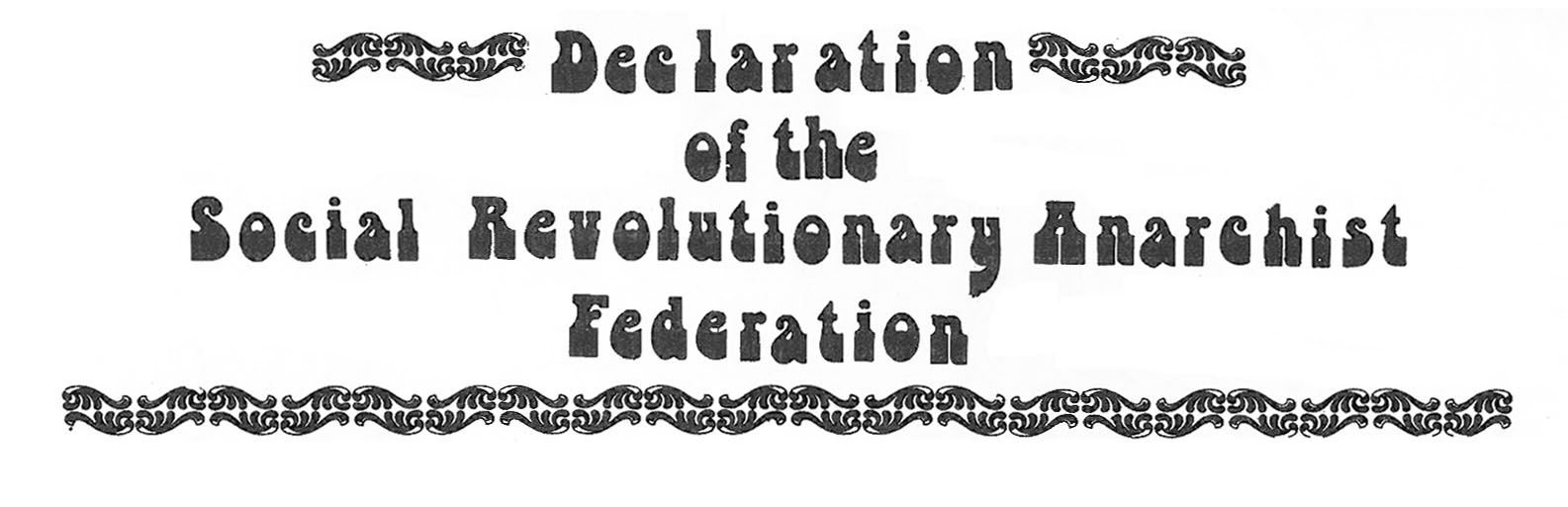
Social Revolutionary Anarchist Federation (SRAF) declaration (1972)

The overwhelming majority of people have no control over the direction or the use to which our lives are put. We fight for self-direction, self-initiation, self-management and the end to all bosses and leaders. We fight for economic freedom, where we can all enjoy the full leisure and wealth we produce, or are kept from producing.

Instead of government, which takes power from us and gives only the weakness of slavery, we propose the cooperative federation of equal people, full of the dignity which authorities and their functionaries deny.

Instead of taxation and the profit system which pretends to distribute wealth and resources in an equitable manner, we propose collective self-management of our surpluses, and collective rationing of any scarcities.

These collective decisions shall be made by popular assemblies, general and open to all. Thus constituted, all will have access to those with the knowledge of how to make, move or produce all things and services; and to those who actually have the needs to be met.

In other words, we will all have access to each other. No longer will bureaucracies isolate us from each other. Gone will be the leaders and the technicians who claim to know, or claim the exclusive expertise to be able to find out how to do everything from making match-books to bargaining for us, for our benefit.

Without the social distortion produced by tax and profit systems, we can cease the production which is a mere waste of time and resources; and which will suffocate everyone in the service of profit and the power accumulations of a very few ruling parasites.

We fight joyfully, irreverently, and resolutely against all hierarchies, all bosses and leaders, all mediating hierarchy. Bureaucrats are a doomed species.

We relate among ourselves as absolute equals, deserving of equal dignity in all things regardless of strength of mind and body. In federation we develop the audacity to change the world.

But no unity can be coerced. As heretics, we invite heresy. Any locality (self-defined) can veto any decision made on a more general basis as it applies to that locality. Dissenting minorities care not to be denied the means of adequate existence to maintain their intellectual, spiritual or physical independence. In the SRAFederation, dissenting minorities cannot be expelled, or denied recognition as anarchists, or even as members of the SRAFederation. Any resignation by a minority must be voluntary and a part of that minority’s process of self-determination.

We federate together to practice anarchist forms of relating among people for social and private purposes.

We practice now the forms we want to see develop further, along with new forms, in the revolutionary society we will help to build.

We federate together now to focus our strength for the maximum impact on society which our energy and numbers can create.

We federate now, not for our children, but so that we ourselves may enjoy the fruits of our efforts. If we do this, there will be a future for our children to build and shape in their own way.

The wreckers of the world — the profit takers, the leaders, generals, popes, and presidents, the authorities and their functionaries, the bureaucrats —  have been doing their worst to us for long enough! It must now end.

It is clear that an anarchist society lies in the future and not the past. Join with us for yourselves and your future.

(adopted by general assembly of the bulletin
April-August, 1972.)

&&&&

The affiliated groups, 7 in Canada and 18 in the US, are listed below the declaration:

ED-SRAF, Edmonton, Alberta
SRAF-Tucson, Tucson, Arizona
TUCSON ANARCHO-FEMINISTS, Tucson, Arizona
VAN-SRAF, Vancouver, British Columbia
NADA, Vancouver, British Columbia
BERKELEY SRAF, Berkeley, California
SRAF-LA, Los Angeles, California
SRAFprint, Mountain View, California
SF-SRAF, San Francisco, California
CC-SRAF, Chicago, Illinois
MAYDAY GANG, Evanston, Illinois
CIA, Ames, Iowa
MFA, Orono, Maine
SRAF-A2, Ann Arbor, Michigan
MESABA SFAF, Cotton, Minnesota
FoM, Buffalo, NY
FREESPACE, New York City
HAL-SRAF, Halifax, Nova Scotia
SRAF, Toronto, Ontario
FRIENDS OF KROPOTKIN, London, Ontario
MAKHNO BRIGADE, Indiana, Pennsylvania
LIVING THEATRE, Pittsburgh, Pennsylvania
SEA SRAF#2, Seattle, Washington
MADISON SRAF, Madison, Wisconsin
MIL-SRAF, Milwaukee, Wisconsin

= = =

taken from Black Star Review, an anarchist publication of the Social Revolutionary Anarchist Federation, vol 1, #3; p 31.

Hakim Bey Joins the IWW (1991)

AN ESOTERIC INTERPRETATION OF THE I.W.W. PREAMBLE

Hakim Bey, the Association for Ontological Anarchy

People who think that they know our politics, who know that we are individualists (or even worse, “neo-individualists”), will no doubt be shocked to discover us taking an interest in the IWW. They’ll be even more flabbergasted to hear that Mark Sullivan & I joined the NY Artists & Writers Job Branch of the IWW this January at the urging of Mel Most (who subsequently went & died on us!). Actually, we’re a bit shocked ourselves. “Never complain, never explain” ……; but perhaps this time we’ll relax the rule a bit — hence the apologia.

The Mackay Society, of which Mark & I are active members, is devoted to the anarchism of Max Stirner, Benj. Tucker & John Henry Mackay. Moreover, I’ve associated myself with various currents of post-situationism, “zero work”, neo-dada, autonomia & “type 3” anarchy, all of which are supposed to be anathema to the IWW & syndicalism in general. Other members of the NY Artists Branch are also individualists or pacifist-anarchists (in the Julian Beck line of transmission); some unease has already been expressed during meetings about the Preamble & other IWW texts…..; so, aside from making a sentimental gesture in honor of Mel’s memory….. why are we collaborating with the IWW?

First: what’s wrong with a little sentiment? When I first discovered anarchism at about 12 or 13 I wanted to be a hobo (more practical ambition than piracy, I figured), & the Wobbly organizers appeared to me as authentic American heros. I still think so.

Continue reading ‘Hakim Bey Joins the IWW (1991)’