
Archive for the 'Anarchism' Category


Libertarian League: “What We Stand For” (1963)

The “free” world is not free; the “communist” world is not communist. We reject both: one is becoming totalitarian; the other is already so.

Their current power structure leads inexorably to atomic war and the probable destruction of the human race.

We charge that both systems engender servitude. Pseudo-freedom based on economic slavery is no better than pseudo-freedom based on political slavery.

The monopoly of power which is the state must be eliminated. Government itself, as well as its underlying institutions, perpetuates war, oppression, corruption, exploitation, and misery.

We advocate a world-wide society of communities and councils based on cooperation and free agreement from the bottom (federalism) instead of coercion and domination from the top (centralism). Regimentation of people must be replaced by regulation of things.

Freedom without socialism is chaotic, but socialism without freedom is despotic. Libertarianism is free socialism.

_ _ _

These ideas are expanded upon in the provisional statement of the principles of the Libertarian League and in other literature that will be supplied free on request.

________________________________________________________________________________________

LIBERTARIAN LEAGUE
P.O. Box 261, Cooper Station
New York 3, N.Y.

= = =

from View and Comments, #45 (Fall 1963), back cover [p 26]

&&&

RADICAL ARCHIVES NOTE: Earlier versions of this statement, which were somewhat shorter, were printed in previous issues of Views and Comments.

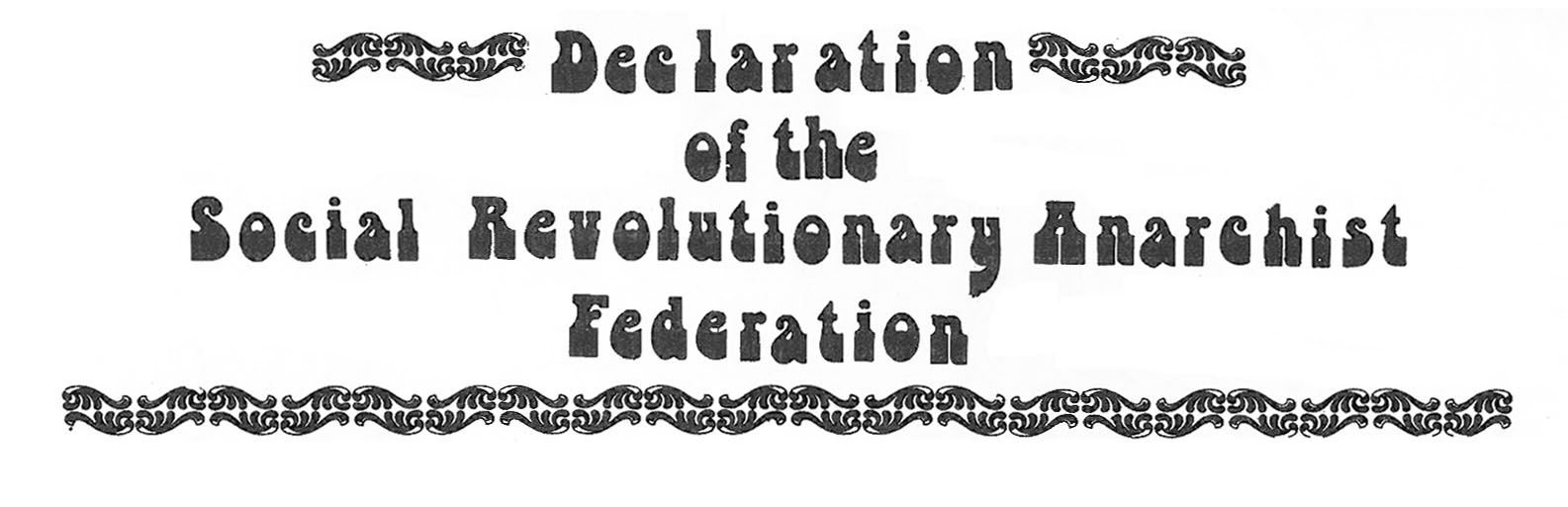
Social Revolutionary Anarchist Federation (SRAF) declaration (1972)

The overwhelming majority of people have no control over the direction or the use to which our lives are put. We fight for self-direction, self-initiation, self-management and the end to all bosses and leaders. We fight for economic freedom, where we can all enjoy the full leisure and wealth we produce, or are kept from producing.

Instead of government, which takes power from us and gives only the weakness of slavery, we propose the cooperative federation of equal people, full of the dignity which authorities and their functionaries deny.

Instead of taxation and the profit system which pretends to distribute wealth and resources in an equitable manner, we propose collective self-management of our surpluses, and collective rationing of any scarcities.

These collective decisions shall be made by popular assemblies, general and open to all. Thus constituted, all will have access to those with the knowledge of how to make, move or produce all things and services; and to those who actually have the needs to be met.

In other words, we will all have access to each other. No longer will bureaucracies isolate us from each other. Gone will be the leaders and the technicians who claim to know, or claim the exclusive expertise to be able to find out how to do everything from making match-books to bargaining for us, for our benefit.

Without the social distortion produced by tax and profit systems, we can cease the production which is a mere waste of time and resources; and which will suffocate everyone in the service of profit and the power accumulations of a very few ruling parasites.

We fight joyfully, irreverently, and resolutely against all hierarchies, all bosses and leaders, all mediating hierarchy. Bureaucrats are a doomed species.

We relate among ourselves as absolute equals, deserving of equal dignity in all things regardless of strength of mind and body. In federation we develop the audacity to change the world.

But no unity can be coerced. As heretics, we invite heresy. Any locality (self-defined) can veto any decision made on a more general basis as it applies to that locality. Dissenting minorities care not to be denied the means of adequate existence to maintain their intellectual, spiritual or physical independence. In the SRAFederation, dissenting minorities cannot be expelled, or denied recognition as anarchists, or even as members of the SRAFederation. Any resignation by a minority must be voluntary and a part of that minority’s process of self-determination.

We federate together to practice anarchist forms of relating among people for social and private purposes.

We practice now the forms we want to see develop further, along with new forms, in the revolutionary society we will help to build.

We federate together now to focus our strength for the maximum impact on society which our energy and numbers can create.

We federate now, not for our children, but so that we ourselves may enjoy the fruits of our efforts. If we do this, there will be a future for our children to build and shape in their own way.

The wreckers of the world — the profit takers, the leaders, generals, popes, and presidents, the authorities and their functionaries, the bureaucrats —  have been doing their worst to us for long enough! It must now end.

It is clear that an anarchist society lies in the future and not the past. Join with us for yourselves and your future.

(adopted by general assembly of the bulletin
April-August, 1972.)

&&&&

The affiliated groups, 7 in Canada and 18 in the US, are listed below the declaration:

ED-SRAF, Edmonton, Alberta
SRAF-Tucson, Tucson, Arizona
TUCSON ANARCHO-FEMINISTS, Tucson, Arizona
VAN-SRAF, Vancouver, British Columbia
NADA, Vancouver, British Columbia
BERKELEY SRAF, Berkeley, California
SRAF-LA, Los Angeles, California
SRAFprint, Mountain View, California
SF-SRAF, San Francisco, California
CC-SRAF, Chicago, Illinois
MAYDAY GANG, Evanston, Illinois
CIA, Ames, Iowa
MFA, Orono, Maine
SRAF-A2, Ann Arbor, Michigan
MESABA SFAF, Cotton, Minnesota
FoM, Buffalo, NY
FREESPACE, New York City
HAL-SRAF, Halifax, Nova Scotia
SRAF, Toronto, Ontario
FRIENDS OF KROPOTKIN, London, Ontario
MAKHNO BRIGADE, Indiana, Pennsylvania
LIVING THEATRE, Pittsburgh, Pennsylvania
SEA SRAF#2, Seattle, Washington
MADISON SRAF, Madison, Wisconsin
MIL-SRAF, Milwaukee, Wisconsin

= = =

taken from Black Star Review, an anarchist publication of the Social Revolutionary Anarchist Federation, vol 1, #3; p 31.
Hakim Bey Joins the IWW (1991)

AN ESOTERIC INTERPRETATION OF THE I.W.W. PREAMBLE

Hakim Bey, the Association for Ontological Anarchy

People who think that they know our politics, who know that we are individualists (or even worse, “neo-individualists”), will no doubt be shocked to discover us taking an interest in the IWW. They’ll be even more flabbergasted to hear that Mark Sullivan & I joined the NY Artists & Writers Job Branch of the IWW this January at the urging of Mel Most (who subsequently went & died on us!). Actually, we’re a bit shocked ourselves. “Never complain, never explain” ……; but perhaps this time we’ll relax the rule a bit — hence the apologia.

The Mackay Society, of which Mark & I are active members, is devoted to the anarchism of Max Stirner, Benj. Tucker & John Henry Mackay. Moreover, I’ve associated myself with various currents of post-situationism, “zero work”, neo-dada, autonomia & “type 3” anarchy, all of which are supposed to be anathema to the IWW & syndicalism in general. Other members of the NY Artists Branch are also individualists or pacifist-anarchists (in the Julian Beck line of transmission); some unease has already been expressed during meetings about the Preamble & other IWW texts…..; so, aside from making a sentimental gesture in honor of Mel’s memory….. why are we collaborating with the IWW?

First: what’s wrong with a little sentiment? When I first discovered anarchism at about 12 or 13 I wanted to be a hobo (more practical ambition than piracy, I figured), & the Wobbly organizers appeared to me as authentic American heros. I still think so.

Continue reading ‘Hakim Bey Joins the IWW (1991)’

Revolutionary Socialist League (RSL): “What We Stand For” (1984)

WHAT WE STAND FOR

Program in Brief of the Revolutionary Socialist League

1. The REVOLUTIONARY SOCIALIST LEAGUE is an organization dedicated to the fight for freedom for all the world’s people – freedom from poverty and hunger; from racism and all forms of national, sexual, age and class-related oppression; from privileged rulers and wars – freedom from capitalism.

We believe that that this fight is more necessary than ever. Today, the world capitalist system is sliding deeper and deeper into a massive economic, political and social crisis. This crisis is bringing conditions as bad as or worse than the Great Depression of the 1930s. In all countries, the ruling classes are responding to the crisis by bludgeoning down the living standards of the masses of people and curtailing our rights. Unemployment and wage-cutting, cutbacks in social services and a beefing up of the repressive apparatus – the police, military, prisons, etc. ­ – all are part of the capitalist attack. As in the 1930s, the crisis is paving the way for the rise of fascist groups eager to impose their genocidal solution on humanity.

Internationally, the crisis will cause the battles among the different blocks of national capitalists to flare into full-scale wars, as each seeks to defend and increase its power, markets, investment outlets and control of natural resources against the others. Twice already in this century the capitalists have fought devastating world wars, in which millions of people have died. Now, with this development of huge nuclear arsenals capable of blowing up the planet hundreds of times over, human civilization itself hangs in the balance.

Thus the continued existence if the capitalist system is pushing us closer every day to depression, fascism, world war and possibly total destruction.

Continue reading ‘Revolutionary Socialist League (RSL): “What We Stand For” (1984)’

Norman Cohn on the heresy of the Free Spirit (1951)

The heresy of the Free Spirit therefore demands a place in any survey of revolutionary eschatology – and that is still true even though its adherents were not social revolutionaries and did not find their followers amongst the turbulent masses of the urban poor. They were in face gnostics intent on their own individual salvation; but the gnosis at which they arrived was a quasi-mystical anarchism – an affirmation of freedom so reckless and unqualified that it amounted to a total denial of every kind of restraint and limitation. These people could be regarded as remote precursors of Bakunin and of Nietzsche – or rather of that bohemian intelligentsia which during the last half-century has been living from ideas once expressed by Bakunin and Nietzsche in their wilder moments. But extreme individualists of that kind can easily turn into social revolutionaries – and effective ones at that – if a potentially revolutionary situation arises. Nietzsche’s Superman, in however vulgarized a form, certainly obsessed the imagination of many of the ‘armed bohemians’ who made the National Socialist revolution; and many a present-day exponent of world revolution owes more to Bakunin than to Marx. In the later Middle Ages it was the adepts of the Free Spirit who conserved, as part of their creed of total emancipation, the only thoroughly revolutionary doctrine that existed. And it was from their midst that doctrinaires emerged to inspire the most ambitious essay in total social revolution which medieval Europe was ever to witness.

= = =

Norman Cohn, The Pursuit of the Millennium: Revolutionary Millenarians and Mystical Anarchists of the Middle Ages, Revised and Expanded Edition (NY: Oxford University Press, 1951/1970), pp 148–49.

Nettlau on Bakunin and syndicalism (1914)

Here Bakunin’s Socialism sets in with full strength: mental, personal, and social freedom to him are inseparable – Atheism, Anarchism, Socialism an organic unit. His Atheism is not that of an ordinary Freethinker, who may be an authoritarian and an anti-Socialist; nor is his Socialism that of an ordinary Socialist, who may be, and very often is, an authoritarian and a Christian; nor would his Anarchism ever deviate into the eccentricities of Tolstoi and Tucker. But each of these three ideas penetrates the other two an constitutes with them a living realisation of freedom, just as all our intellectual, political and social prejudices and evils descend from one common source – authority. Whoever reads “God and the State,” the best known of Bakunin’s many written expositions of these ideas, may discover that when the scales of religion fall from his eyes, at the same moment also the State will appear to him in it horrid hideousness, and anti-Statist Socialism will be the only way out. The thoroughness of Bakunin’s Socialist propaganda is, to my impression, unique.

From these remarks it may be gathered that I dissent from certain recent attempts to revindicate Bakunin almost exclusively as a Syndicalist. He was, at the time of the International, greatly interested in seeing the scattered masses of the workers combining into trade societies or sections of the International. Solidarity in the economic struggle was to be the only basis of working-class organization. He expressed the opinion that these organisations would spontaneously evolve into federated Socialist bodies, the natural basis of future society. This automatic evolution has been rightly contested by our Swiss comrade Bertoni. But did Bakunin really mean it when he sketched it out in his writings of elementary public propaganda? We must not forget that Bakunin – and here we touch on one of his shortcomings – seeing the backward dispositions of the great masses in his time, did not think it possible to propagate the whole of his ideas directly among the people. By insisting on purely economic organisation, he wished to protect the masses against the greedy politician who, under the cloak of Socialism, farms and exploits their electoral “power” in our age of progress! [[7]]

I say again: it is preposterous to think that Bakunin would have been a syndicalist and nothing else – but what he would have tried to make of Syndicalism, how he would have tried to group these and many other materials of revolt and to lead them to action, this my imagination cannot sketch out, but I feel that things would have gone otherwise, and the capitalists would sleep less quietly. I am no admirer of personalities, and have many faults to find with Bakunin also on other grounds; but this I feel, that where he was rebellion grew round him, whilst to-day, with such splendid material, rebellion is nowhere. South Africa, Colorado, are ever so hopeful events; but think what a Bakunin would have made of them – and then we can measure the value of this man in the struggle for freedom. [[11]]

= = =

Max Nettalu, “Michael Bakunin” in Writings on Bakunin (London: Carl Slienger, 1976), pp 7, 11.

The book’s notes indicate that the essay was originally published in Freedom, June 1914.

Anarchist ‘Views & Comments’ on Hal Draper and the International Socialist League (ISL) (1956)

STALINISM WITHOUT STALIN

In spite of serious ideological and political differences with the Independent Socialist League, we have long considered their weekly paper, LABOR ACTION, to be one of the best radical publications in the country. The current series of articles by Hal Draper on “Stalinism Without Stalin” should be read carefully by every one interested in the recent switch inside the Soviet Union.

After giving considerable background material, much of which is already well known throughout the anti-Stalinist left, comrade Draper takes issues with those who see in the events in Russia changes of a fundamental nature in the regime itself. He declares that Stalinism continues intact without Stalin. He demonstrates conclusively, with a wealth of detail and examples coupled with sound reasoning, that the present “collective leadership” in Moscow is every bit as totalitarian as was the one-man leadership of Stalin. Numerous examples are given and the whole subject is done up brown – except for one important part, and this to us is decisive.

Continue reading ‘Anarchist ‘Views & Comments’ on Hal Draper and the International Socialist League (ISL) (1956)’

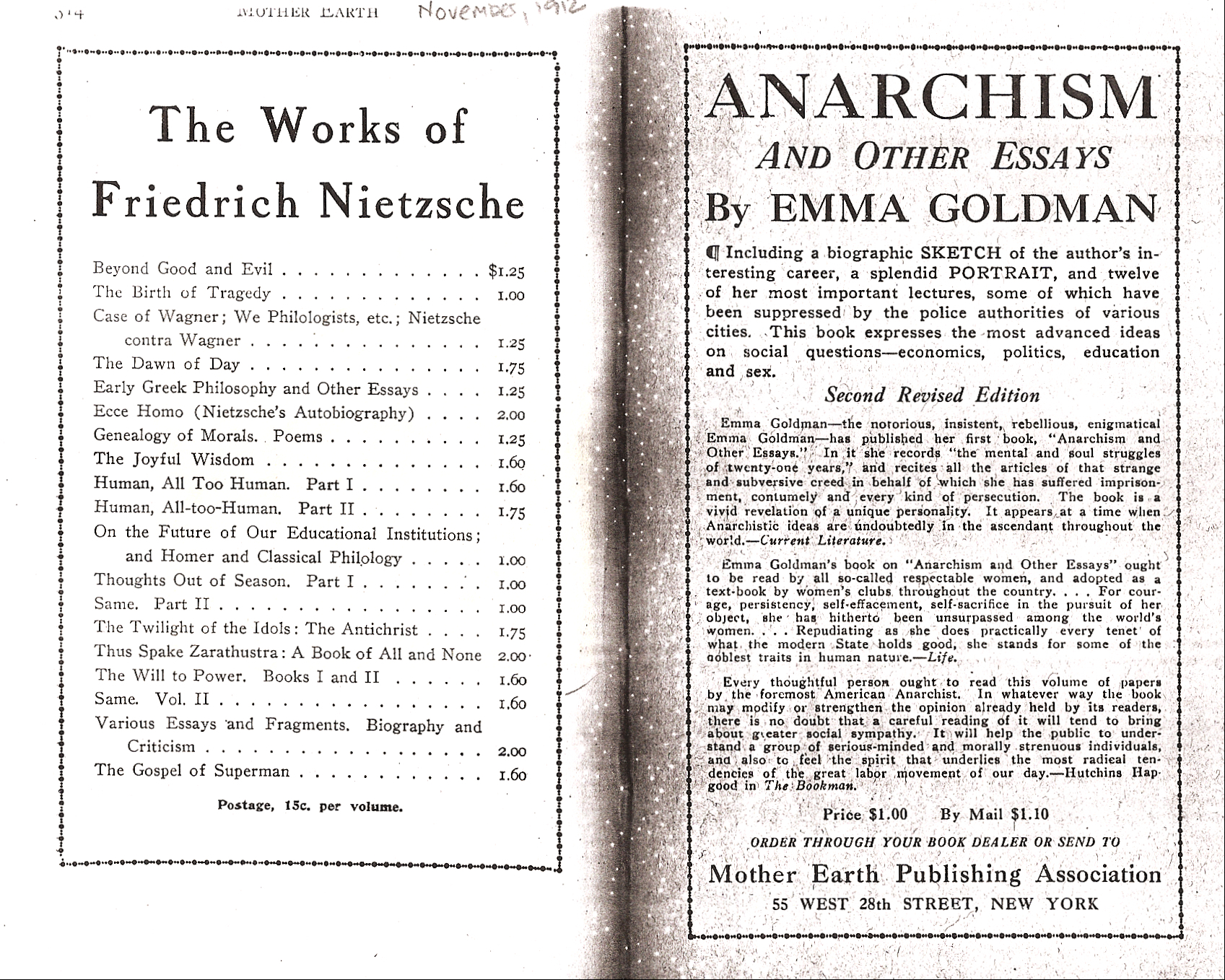
Emma Goldman’s ‘Mother Earth’ & Nietzsche

Below is an ad from Emma Goldman’s journal Mother Earth, advertising the collected works of Frederich Nietzsche, which could be ordered directly through the magazine. This ad originally appeared in the November 1912 issue, and the magazine offered Nietzsche’s works for sale through 1914.

New World Liberation Front (NWLF) – 1977 article

RADICAL ARCHIVES note: Some readers will be particularly interested in the NWLF’s explicitly antisemitic “anti-Zionist” theories, as mentioned in the middle of the article.

NWLF: good hit, no pitch
Celine Hagbard

The New World Liberation Front, a Marxist-Leninist-Maoist organization which has carried out an uninterrupted urban guerilla offensive around the Bay Area and Northern California for almost three years, may well be the most tactically advanced guerilla group in the United States. As a result of recent theoretical pronouncements on anarchism, feminism, homosexuality and Zionism, however, they have made themselves the most controversial guerillas within the revolutionary left as well.

Continue reading ‘New World Liberation Front (NWLF) – 1977 article’

Hardt & Negri on anarchists (2000)

“You are just a bunch of anarchists, the new Plato on the block will finally yell at us. That is not true. We would be anarchists if we were not to speak (as did Thrasymacus and Callicles, Plato’s immortal interlocutors) from the standpoint of a materiality constituted in the networks of of productive cooperation, in other words, from the perspective of a humanity that is constructed productively, that is constituted through the “common name” of freedom. No, we are not anarchists but communists who have seen how much repression and destruction of humanity have been wrought by liberal and socialist big governments. We have seen how all this is being re-created in imperial government, just when the circuits of productive cooperation have made labor power as a whole capable of constituting itself in government.”

= = =

Michael Hardt & Antonio Negri, Empire (Cambridge, MA & London: Harvard University Press, 2000), p 350. [Italics in the original.]