You can now follow Radical Archives on twitter! @radarchive77
Boyd Rice on Tom Metzger’s “Race and Reason” (1986)
Published January 15, 2024 Antisemitism , Counterculture & Punk , Fascism Leave a CommentComing soon: the transcription of Boyd Rice’s 1986 appearance on Tom Metzger’s talk show Race and Reason.

“People of America, I direct this statement to you. It concerns how to prevent another Manhattan [9/11] and deals with the causes and effects of the war against America. Before I begin, I say to you that contrary to Bush’s claim that we hate freedom, security is an indispensable pillar to human life. Free men do not forfeit their security. If we hate freedom, then explain why we did not strike, for example, Sweden. We know that those who hate freedom do not possess the defiant spirit like those of the nineteen [September 11 highjackers]. May God have mercy upon them.”
Osama bin Laden, “Second Statement to the American People,” in Osama bin Laden: America’s Enemy in His Own Words, ed. Randall B. Hamud (San Diego: Nadeem Publishing, 2005)
Could a CNT-UGT Alliance Have Won the Spanish Civil War?
Published November 14, 2022 Anarchism Leave a CommentBased on his experiences as a journalist covering the Spanish Civil War from late summer 1936 to early 1937, Franz Borkenau’s The Spanish Cockpit gives a sympathetic but critical view of the various Left and liberal factions — with a focus on anarchists in the CNT-FAI, the non-Stalinist but Marxist POUM, the Stalinist CP, and the socialists in the UGT. In his conclusion, he gives an interesting assessment about how the out-gunned Spanish republic could have defeated Franco’s alliance of fascists and others on the Far Right (although he doubts even this would be workable due to what he saw as the real desires of the Spanish people).
“To-day the communists in Spain combine both the revolutionary centralization of Robespierre and the Thermidorian policy of his successors. They make a dictatorship, but it is a dictatorship not in favour of the revolutionary classes. Such a policy could not last for a fortnight if republican Spain had to live on the enthusiastic support of the people; it can last, and will doubtless continue to last, because the Spanish people have failed to make their own revolution efficient. The Trotskyists, who complain so bitterly about this result, must blame themselves for it. In fact, they are even more to blame than any other group. They have, in their mechanical repetition of formulae from books about Marxism and the Russian revolution, been unable to create a mass movement at all. Anarchists and socialists at least succeeded in doing that. But probably in this case, as in so many others, it is superficial to blame individual groups and leaders at all.
Had the Trotskyists in Spain not been dogmatic Marxists of foreign inspiration, they would have been nearer to Spanish realities. But then they would have been a genuinely Spanish movement, which is to say they would have been exactly like those socialists and anarchists who have so conspicuously not succeeded. From whatever aspect the problems of the Spanish revolution are treated, from whatever starting-point discussed, the final result is always that things might have been otherwise provided that—Spain were not Spain. Had the Spaniards been able to create a revolutionary movement strong enough to beat a counter-revolution armed with European arms, then Russian help would have been superfluous, then things would have taken another turn, then socialists and anarchists would have gradually merged into one single revolutionary party, backed by the spontaneous enthusiasm of both workers and peasants; they would have won the war, and created a new order of things, less dictatorial, more humane and more progressive than the present Russian regime.”
= = =
Source: Franz Borkenau, The Spanish Cockpit: An Eye-Witness Account of the Political and Social Conflicts of the Spanish Civil War, “Conclusions” chapter; originally published 1937.
Do Fanzines Fund the Anarchist Movement?
Published June 6, 2021 Anarchism , Counterculture & Punk Leave a CommentWhile an otherwise pretty good essay considering that one of its authors was the chief of the Eugene, Oregon police department, there is one line that has always stuck out to me:
“Many of the higher level [anarchist] organizers and activists have taken to traveling by bus or even airplane and many of them have traveled internationally, especially to Europe. Little is know of the financing structure for that kind of work. Funding sources such as voluntary contributions, book sales, “distros” (selling of shirts, symbols, etc.), and ‘zine sales appear to be the back-bone of financing.”
Keep selling those zines, kids – the higher level organizers are counting on you!
= = =
from Randy Borum and Chuck Tilby, “Anarchist Direct Actions: A Challenge for Law Enforcement,” Studies in Conflict & Terrorism 28:210-233 (2005)
The Sino-Soviet Split as Revisionism versus Global Race War
Published November 26, 2020 Marxism , Nationalism , Theory Leave a Comment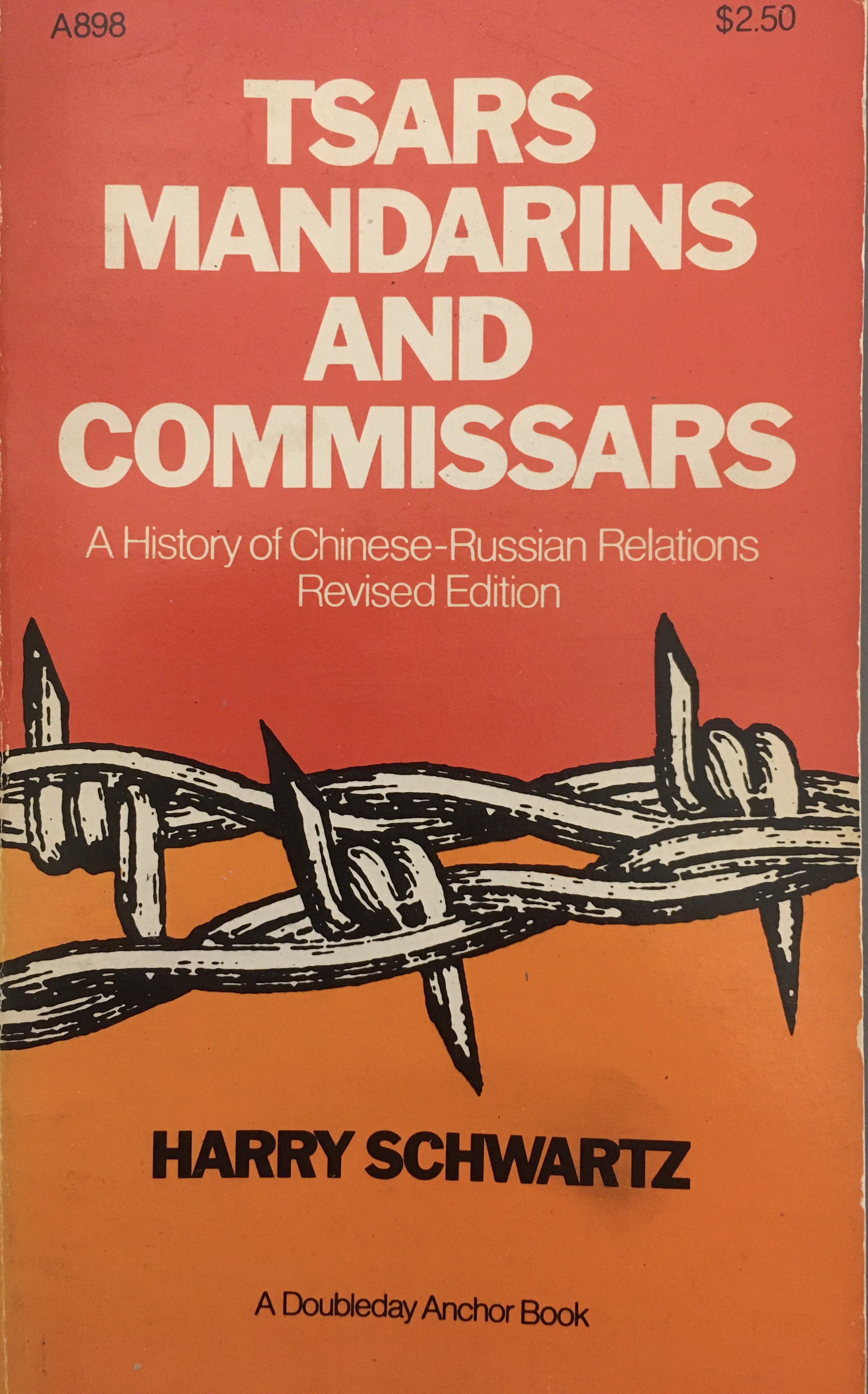 …the second world conference of Communist parties was held in Moscow in November 1960. Though its proceedings were secret, enough information leaked out afterward to make clear this was a vituperative, no-holds-barred fight between the Soviet and Chinese representatives and their respective supporters. The Peking representatives denounced the attitude of the Soviet government toward their country and the Soviet support for India. They accused the Soviet Communist party of fostering a political line that encouraged surrender to the imperialists. They demanded greater militancy and willingness to take risks, arguing that talk of peaceful coexistence [which the USSR was pursuing the US] was useful only to secure the moral disarmament of the capitalist peoples and the material disarmament of their governments. The Chinese struck out at Khruschev’s criticism of Stalin’s “cult of personality” and accused him and his followers of revisionism and opportunism. Khruschev and his supporters gave as good as they got. Khruschev called Mao Tse-tung a “megalomaniac warmonger” and accused the Chinese of failing completely to understand the nature of modern war and its dangerous consequences. The Soviet representatives accused the Chinese of trying to disrupt various Communist parties and slandering Khruschev and seeking to have him purged from his posts in Moscow. This was clearly the bitterest and stormiest meeting in the history of the world Communist movement. The document that emerged from it as the platform of world Communism was a compromise so worded that each side could point to it and claim that its own position had been vindicated and supported. This document was a device aimed at avoiding an open break, not a means for healing the chasm that had developed.
#
Finally he [Khruschev] came to the nub of the matter. “The left sectarian disorder is fed by nationalism, and in turn it feeds nationalism.” By this statement he really accused the Chinese of serving their own national interests under the guise of being ultra-revolutionary Communists.
The Chinese point of view was expressed in a number of lengthy statements. Here we shall present only the key points made by Peking in these declarations.
First, Peking made clear that it regarded the struggle in the underdeveloped countries of Asia, Africa and Latin America as the center of all revolutionary activity in the world, declaring that to further this struggle it was necessary to be prepared to take risks of a spark setting off a general conflagration. The Soviet effort to curb the militancy of revolutionaries in these countries was denounced bitterly. Later Moscow was to charge that by this line the Chinese were trying to make themselves the heads of an Asian-African-Latin American bloc based on racism—on a struggle of non-whites against whites—rather than on Marxist principles of class struggle between workers and employers.
Without naming the Chinese directly, a Soviet commentator writing in the spring of 1963 described the Chinese policy at the Afro-Asian Peoples Conference held in Moshi, Tanganyika in February 1963, a meeting where the right of Soviet delegates to participate was contested on the ground that they came from Europe not Asia:
Some of the more chauvinistically-inclined leaders would like to direct the solidarity movement not against imperialism, colonialism and its agents, but against all white people. They are ready to sacrifice the truth, as they did, so far cautiously, in Moshi, and to shrug their shoulders at the participation (even though only partial) of international organizations such as the World Council of Peace. … They sacrifice the truth because they pretend the liberation of Asia, Africa and Latin America is possible even without the participation of progressive organizations throughout the world, without those white people who because of their views actively fight against imperialism and its colonial attributes.
#
The Russian reply of March 30, 1963 was a lengthy and mildly worded exposition of the Soviet ideological position. … This letter was written after the Afro-Asian Solidarity meeting in Moshi, Tanganyika at which the Chinese had shown they had looked on the Russian as whites having no place in Asia. Hence, in one of the most significant sentences of the Soviet letter, the men in Moscow warned: “The militant call ‘Workers of all countries, unite!’ formulated by Marx and Engels means that at the basis of this unity lies anti-imperialist class solidarity and not any principle of nationality, color or geographical location. The German magazine, Christ und Welt, reported on July 5, 1963 that Chinese delegates at the Afro-Asian Journalists Conference in Djakarta in the spring of 1963 declared that Russia would have to return the former Chinese areas of Siberia if it wished to be welcomed at Afro-Asian meetings. The Chinese called the delegates from Soviet areas in Asia ‘marionettes of a white imperialist power.’”
On June 14, 1963, they [the Chinese leaders] sent the Soviet leaders their answer to Moscow’s March 30 letter. …
On the major policy issues dividing the two sides, the Chinese broadside repeated the customary demands for greater militancy, the old skepticism of peaceful transition from capitalism to socialism, the usual advocacy of reliance on armed revolution and the like. But it was on the issue of the struggle in Asia, Africa and Latin America that the Chinese laid down their harshest dictum, one which came close to accusing Premier Khruschev of being an advocate of continued colonialism and white supremacy. The passage merits quotation:
The various types of contradictions in the contemporary world are concentrated in the vast areas of Asia, Africa and Latin America; these are the most vulnerable areas under imperialist rule and the storm centers of world revolution dealing direct blows at imperialism…
The anti-imperialist revolutionary struggles of people in Asia, Africa and Latin America are pounding and undermining the foundations of the rule of imperialism and colonialism, old and new, and are now a mighty force in defense of world peace. In a sense, therefore, the whole cause of the international proletarian revolution hinges on the outcome of the revolutionary struggles of the peoples in these areas who constitute the overwhelming majority of the world’s population. Therefore, the anti-imperialist revolutionary struggle of the people in Asia, Africa and Latin America is definitely not merely a matter of regional significance but one of overall importance for the whole cause of proletarian revolution.
Certain person’s now go so far as to deny the great international significance of the anti-imperialist revolutionary struggles of the Asian, African and Latin American people and on their pretext of breaking down the barriers of nationality, color and geographical location, are trying their best to efface the line of demarcation between the oppressed and oppressor nations and between oppressed and oppressor countries and to hold down the revolutionary struggles of the peoples in these areas. In fact, they cater to the needs of imperialism and create a new ‘theory’ to justify the rule of imperialism in these areas and the promotion of policies of old and new colonialism. Actually, this ‘theory’ seeks not to break down the barriers of nationality, color and geographical location but to maintain the rule of the ‘superior nations’ over the oppressed nations. It is only natural that his fraudulent ‘theory’ is rejected by the people in these areas.
Here the Chinese were hitting the Soviet leaders at an extremely important and sensitive point. The Chinese demand could be read as urging that the Communist movement concentrate not only against Western imperialism, but also against the Russian position in Asia, against rule by the “superior” Russian nation over the Uzbecks, the Turkmens, the Bashkirs, the Yakuts and the numerous other Asian nations incorporated in the Soviet Union.
#
The Soviet reply to the Chinese was published on July 14 [1963]…. The next long section of the letter deals with the Chinese demand for primacy of revolution in Asia, Africa and Latin America. Before taking up this issue, the Soviet statement had already thrown out broad hints that the Chinese were really anti-white racists, declaring, for example, that the Chinese
…came out against the participation of representatives…of the European socialist countries in the Third Afro-Asian Conference in Moshi [Tanganyika]. The leader of the Chinese delegation told the Soviet representative that ‘there was nothing for whites to do.’ At the journalists’ conference in Jakarta, the Chinese representatives followed a line against allowing Soviet journalists full participation on the ground that the Soviet Union is not an Asian country!
The Soviet letter also points to the racist implications of the favorite Chinese slogan, “The wind from the East will prevail over the wind from the West,” noting that slogan was one “lacking all class content.” But it is in the refutation of the Chinese demand for a special position for Asia, Africa and Latin America that the Soviet statement makes the sharpest accusations that the Chinese have deserted Marxism-Leninism for a racist approach. Peking, the Soviet letter charges, is trying “to win popularity among the peoples of Asia, African and Latin America in the easiest way.” The Chinese, by insisting on the national liberation movement as the decisive force in the struggle against imperialism, are actually “isolating the national-liberation movement from the international working class and its offspring, the world system of socialism.” The Chinese are violating the Leninist injunction that the working class must head the struggle against imperialism, the Soviet letter charges, and “the Chinese comrades want to ‘correct’ Lenin and prove that it is not the working class but the petty bourgeoisie or the national bourgeoisie, or even ‘certain patriotic-minded kings, princes and aristocrats,’ who should be the leaders of the world struggle against imperialism.” And this hinting that racism rather than Marxism animates the Chinese, the Soviet letter asks darkly:
What is the explanation for the false tenets of the Chinese Communist party leadership on the vital problems of our time? Either the complete estrangement of the Chinese comrades from actual reality, a dogmatic bookish approach to the problems of war, peace, and revolution, a lack of understanding of the concrete conditions of the modern epoch: Or do other goals, having nothing in common with revolution, hide behind the deafening noise about ‘world revolution’?
#
On October 1, 1963, another bitter Chinese article assailed the Soviet leaders as “apologists of neocolonialism.” It accused them of having failed in their obligations to the Algerian revolution and of working with the United States to use the United Nations to put down the Congolese people’s armed struggle against colonialism. The Soviet leaders’ policy and purposes in giving aid to newly independent nations was declared “open to suspicion” since these leaders “often take an attitude of great power chauvinism and national egoism in matters concerning aid to newly independent countries, harm the economic and political interests of the receiving countries, and as a result discredit the socialist countries.” But the most serious attack came on the subject of racism. The Soviet leaders were accused of emulating German Kaiser Wilhelm II in his strictures a half century ago about the “yellow peril.” The motives of Soviet leaders in attacking alleged Chinese racism were described in these terms:
When they peddle the ‘theory of racism,’ describing the national liberation movement in Asia, Africa and Latin America as one of the colored against the white race, the leaders of the Communist party of the Soviet Union are clearly aiming at inciting racial hatred among the white people of Europe and North America, at diverting the people of the world from the struggle against imperialism, and at turning the international working class movement away from the struggle against modern revisionism.
The Chinese summed up their case in October by declaring Khruschev had joined in a new “Holy Alliance” with President Kennedy against the people of the world, hinting broadly that the goal is a Soviet-American condominium over all mankind.
#
On October 1, 1972, China celebrated the twenty-third anniversary of its Communist regime. … The occasion was marked in Moscow, too. A statement of congratulation to the Chinese people was issued, a statement that included a reference to the “complete theoretical incompetence of Maoism and its incompatibility with scientific socialism.”
= = =
Harry Schwartz, Tsars, Mandarins and Commissars: A History of Chinese-Russian Relations, Revised Edition (Anchor: Garden City, NJ, 1973); 200; 210–11; 219–20, 223, 230–31; 233, 238–40; 256–57; 282
Max Shachtman on Democratic Workers Councils and the “Workers’ Government”
Published May 28, 2020 Marxism , Theory Leave a CommentShall economic life be democratically managed and controlled?
Absolutely! It is the maintenance of capitalist domination of society that demands, more and more, the abandonment of democracy. A Worker’s Government would have to extend democracy continually, not merely because it is a desirable ideal, but because it is indispensable to the planning of production for use. …
If, however, production were carried on for use, to satisfy the needs of the people, the question immediately arises: Who is to determine what is useful and what would satisfy these needs? Will that be decided exclusively by a small board of government planners? No matter how high-minded and wise they might be, they could not plan production for the needs of the people. Production for use, by its very nature, demands constant consultation of the people, constant control and direction by the people. The democratically-adopted decision of the people would have to guide the course of production and distribution. Democratic control of the means of production and distribution would have to be exercised by the people to see to it that their decision is being carried out.
Otherwise, the government and its planning would undergo a complete perversion of its purpose. At best, we would have a benevolent regimentation of the people “for their own good.” A government which declares itself to be “for” the workers, but is not a government of and by the workers, is a Workers Government only in name. Instead of being regulated by the blind market, as under capitalism, production would be regulated by the autocractic, uncontrolled will of a bureaucracy. Economic distortions, social conflict, exploitation and oppression would inevitably result. Production for use, aimed at satisfying the needs of society and freeing all the people from class rule, would be impossible.
Democratic control, the continual extension of democracy, is therefore an indispensable necessity under a Workers Government. The idea of a Workers Government is this inseparably connected with the idea of nationalization of the means of production and exchange, the centralized organization and planning of production and distribution, and the continual extension of democracy and democratic control. No one of these can exist in the absence of others. To have democratic control of industry, there must be planning of production. To plan production, the economic machinery of the country must be socially owned and centrally operated. To nationalize the means of production and exchange, a Worker’s Government must be established with power to act. For it to be a Workers’ Government, it must be democratically run and controlled by workers. None of these is possible without having all. ….
[Shachtman then argues that initially the Workers’ State would have to remain an instrument of force, in order to hold back reactionary attempts to end the revolution; and that the new State would inherit social inequality from the prior, capitalist society—something the Workers State would struggle against.]
These characteristics of the Workers’ Government show its similarities with the preceding state. But it is in its fundamental differences with it that the workers’ state shows, as the founders of scientific socialism have put it, that it is no longer a state in the classic sense of the word. A whole world of difference separates the two.
First, the force at the disposal of the workers’ state would not reside in bodies of armed men separated from the people, and under capitalism or feudalism or slavery. The arms would be in the hands of the workers themselves. The government which could summon these arms into action would be in the hands of the workers themselves.
Second, the state power would no longer be the instrument of an exploiting minority for the domination of the exploited majority. For the first time in history, the state would be in the hands of the majority to be used whenever necessary against the reactionary or anti-social minority.
Third, the state power would no longer be governed by a special or professional bureaucracy. It would be ruled and controlled by the people. It would have no permanent officials, and all elected officers would be subject to immediate recall by their electors. By virtue of its system of democratic representation, which will be dealt with in detail further on, every worker will participate directly in the affairs of government, from the humblest to the most prominent.
# # #
The parliamentary form of government, supposed to be the best expression of the will of the people, is nicely suited to cover up the actual rule of the enormously wealthy minority which monopolizes industry, banking and transportation.
The workers cannot possibly rule by means of such a governmental machine. It will have to be replaced from top to bottom by an entirely different form and machinery of government. A workers’ government has as its main task the centralization and planned organization of production, under democratic control, for the welfare of the people. This task can be accomplished only if there is a form of government suited to it.
If the workers are to be assured of control of the administration of industry, and if the centralized planning of production and distribution is to be under their democratic control, it follows that the government must be based directly on the workers and under their constant control. The only way in which this can be effectively done is by having the government elected directly by the workers in the industries. Just how would this work?
Every factory and other center of production or distribution would be administered by a Council, elected by the workers and subject to recall at any time. These Workers’ Councils themselves would run the factory and see to it that the plans [145] and other decisions of the national planning council, or board, are carried out promptly and properly. At the same time, however, these Councils, which are the direct representatives of the producers, would have to have the power to participate democratically in the selection of the national planning council and in the decisions that it makes. Without such democratic participation and control, planning would soon become bureaucratic and would not represent the interests of the masses.
The municipal, state and federal governments would therefore be composed of direct representatives of the Workers’ Councils, elected by popular ballot and likewise subject to recall at any time. (In the agricultural regions, the Councils would of course be elected by the agricultural workers and farmers.) The National Congress of Councils would elect its officers, committees and boards, again under its direct control and subject to recall. Legislative and executive functions would be exercised by a single power. The decisions of the Council government would not be carried out by a professional bureaucracy, separated from the people and beyond their control. They would be carried out, instead, by the state, municipal and industrial Councils, composed of workers themselves and constantly subject to their control.
Only under such a form of government can we have a genuine workers’ democracy, in which millions and ten of millions actually rule, in contrast with the most advanced capitalist democracy in which thousands, or tens of thousands at most, are the actual rulers.
If the laws adopted or the work carried out by the National Councils’ Congress are not satisfactory, it can be recalled and replaced by the direct action of the Workers’ Councils, without having to wait for two or four or even six years to change the government. If the decisions and plans of the National Congress are satisfactory, but are not being carried out satisfactorily by the Municipal or Factory Council, the latter can be recalled and replaced by the same direct action.
Every worker becomes a direct part of the government administration. His power is not confined to marking a ballot once a year. He exercises his power, his control, his participation in making decisions and carrying them out, every day in the year, year-in and year-out.
= = =
From Max Shachtman, The Fight for Socialism: The Principles and Program of the Workers Party (New York: New International Publishing Co, 1946).
first section is from “Chapter VII: A Workers Government and Socialism”: pp. 115, 116-17, 125.
second section is from “Chapter VIII. The Need for a Revolutionary Party”: pp. 144-46.
Transcriptions from the original book; it is available online as both text and PDF at Marxists.org.
The U.S. Neo-Nazi Rise Above Movement’s 2018 European Vacation
Published May 9, 2020 Counterculture & Punk , Fascism Leave a Comment… As had been announced in advance, martial artists from the US competed at the “Kampf der Nibelungen” (Fight of the Nibelungs) tournament in Ostritz, eastern Saxony, Germany. Inquiries revealed that meant leaders of the Rise Above Movement (RAM), known neo-Nazis from southern California.
RAM was established in early 2017 and for a while also called itself DIY Division; journalists in the US call them the “Alt-Right Fight Club.”[1] “Alt-Right” is the designation for the far-right activist wing of Donald Trump’s supporters, comparable with the European “New Right.” Europe’s New Right, characterized by groups like Identitäre Bewegung [Identitarian Movement], has in fact been a significant influence on RAM.
RAM has its own training spaces in California, where it primarily trains for street fights. Additionally, in late 2017, the group created its own line of clothing called Right Brand Clothing. Their online store also sells gear from Ukrainian neo-Nazi brand Svastone.

Robert Rundo attacking a counterdemonstrator in Huntington Beach.
In its rather short history, RAM participated in every major physical altercation connected to Alt-Right marches in 2017, including the Make America Great Again march in Huntington Beach, California, in March and in Berkeley and Charlottesville in August. It coordinated its participation with Identity Evropa, the American offshoot of Identitäre Bewegung.

Ben Daley (r.) of Rise Above Movement with another RAM member (Photo: EXIF-Recherche)
In Ostritz, RAM was represented Robert Rundo, Ben Daley, and one other unknown person who apparently is originally from Eastern Europe. Daley was briefly imprisoned for possession of a revolver without a permit, while Rundo is looking at twenty months in jail for repeatedly stabbing and seriously injuring a Latin American man in Queens, New York, in 2009.

Robert Rundo as a fighter in Ostritz 2018 (Photo: EXIF-Recherche)
The stated goal of both RAM and its Right Brand Clothing is to enable “the youth” to defend themselves through MMA so that they can “confront the left-wing onslaught of degeneracy and the drug culture through which it is promoted”—a cliché that can be found, in some form or another, in the self-description of every far-right martial arts brand.
RAM wants to expand and eventually sponsor its own martial artists. Its presence at the Shield & Sword Festival in Ostritz, where the “Kampf der Nibelungen” took place, might therefore be seen as a step in that direction. The group is getting ardent support in that regard from Denis Nikitin, whose own White Rex clothing brand will also soon be available through the online Right Brand Clothing store.

Robert Rundo, Denis Nikitin, and an unknown member of RAM (left to right) in Kiev, April 2018 (Photo: Facebook screenshot).
But Ostritz was only one leg of RAM’s European tour. Only a week later, Rundo and Daley together with Denis Nikitin and Tomasz Skatulsky were hosted in Kiev, Ukraine. There, Rundo and Skatulsky not only participated in a right-wing rock concert organized by Svastone and featuring German Nazi hardcore band Brainwash, but they also fought in a tournament sponsored by the “Reconquista Club.” This neo-Nazi gym and the Svastone brand are believed to be important supporters of the Ukrainian fascist volunteer Azov Regiment.
After their brief stay in Ukraine, the RAM members also visited Italian fascist party and organization Casa Pound. In practical terms, theirs was a journey to the centers of Europe’s militant neo-fascist movement, from which RAM will undoubtedly take inspiration for developing its own affiliations in the US.

Skyler Segeberg (left side) and Spencer Currie (right side). The center photo shows both with Hammerskins insignia. (Photo: nocara.blackblogs.org).
RAM’s connection with the Hammerskins is also interesting. This also represents another link to the German structure of the “Kampf der Nibelungen,” which is known to be staffed by leading Hammerskins. At least three RAM members are also part of this Nazi fraternity, including Spencer Currie and Skyler Segeberg. Currie was also involved in RAM’s attacks on counterdemonstrators during an Alt-Right march in April 2017. Both Currie and Segeberg are members of the Huntington Beach, California-based band Hate Your Neighbors, which is considered a Hammerskin band. In October 2016, the band played at Hammerfest in Georgia, an event organized by the Confederate Hammerskins. There, they shared the bill with Definite Hate, a band that once included Wade Michael Page, a Hammerskin who shot six people at a Wisconsin Sikh temple before killing himself in August 2012. This is only one indication of just how dangerous the Hammerskins really are.[2]
….
The international network of organizations, the concept of a “pan-Europe,” and the adoption of a society-wide fitness trend allow neo-Nazis to appear progressive and accessible. Moreover, the example of American neo-Nazi group Rise Above Movement, which was present in Ostritz, makes it clear that combat sports are not for casual competition but rather for effective preparation for street fighting.
[1] Anti-Defamation League: “Rise Above Movement (R.A.M.)”, adl.org/resources/backgrounders/rise-above-movement-ram
[2] Antifaschistisches Infoblatt, no. 96: “Soundtrack zum Rassenkrieg”; antifainfoblatt.de/artikel/soundtrack-zum-rassenkrieg
= = =
translation by Joe. Original in German: “Kein Handshake mit Nazis Rückblick und Auswertung des Kampfsportturniers „Kampf der Nibelungen“ auf dem Neonazi-Festival „Schild & Schwert“ am 21.04.2018,” Runter von der Matte – Kein Handshake mit Nazis!, May 14, 2018.
1970s Soviet Antisemitism
Published November 15, 2019 Antisemitism , Marxism , Zionism/Israel/Palestine Leave a CommentThe antisemitism of Stalin’s Doctors’ Plot — and to a lesser extent the Polish, Czech and other pseudo-antizionist antisemitic purges of the 1950s and ’60s — are remembered today. However, much less attention is paid to the Soviet Union’s conspiracy theory turn starting in the 1960s, where the previous hegemony of Orthodox Marxism was rivaled by various pro-Soviet conspiracy theories, often anti-capitalist and anti-imperialist in character. As part of this a vicious antisemitism – usually cloaked in anti-zionist terms – returned as well, and was exported to Soviet-allied groups in the Arab world, including the PLO. With the revival of antisemitism in Russia after the Soviet collapse, this period of Soviet antizionism can be seen as part of an unbroken link in the history of Russian antisemitism.
Roland Evans and Robert Novak, “Moscow vs Zionism”
“For one thing, the official state newspapers [of the Soviet Union]—Pravda and Izvestia—have been preaching fearsome anti-zionism for years. Following the first Brussels Conference On Soviet Jewry in 1971, Pravda labeled Zionism “an enemy of the people”—a phrase echoing the great purge of the 1930s. After a brief respite, the new, more virulent anti-Zionist campaign was triggered by the second Brussels conference.
The new state-supported campaign is manifested by an official Communist Party lecturer named Valery Yemelyanov, a candidate of economic sciences and a professor in the prestigious Institute of Foreign Languages. What makes Yemelyanov’s anti-Zionist campaign so insidious is that his harshest rhetoric came in a Moscow interview with a newspaper closely connected to the Palestine Liberation Organization (PLO).
Yemelyanov delivered opinions that must have startled even anti-Israel PLO activists who are trying to establish a mini-state of their own on the Israeli-occupied West Bank. “World Zionism has become a great power in the world,” he said, elaborating as follows in a breathtaking spiral of charges:
Eighty-percent of the economy of non-Communist nations is concentrated in the hands of “Zionist capitalists.” 95% of the propaganda efforts undertaken in the capitalist world are concentrated in the hands of the Zionists, 99% in the United States.
In words reminiscent of the notorious “Protocols of the Learned Elders of Zion,” Yemelyanov told his PLO interviewers that the world Zionist organization “works in a strictly secret framework” which includes “all the presidents and parliaments of the developed capitalist countries.” The only way to fight this “world” Zionist movement is to establish a world countermovement with the Arabs themselves should lead “because they are the prime objective of the Zionist movement and the leaders of the world struggle against one of its agents—the state of Israel.”
Such nonsense would not be worth a second glance were it not for the likelihood….that behind it is the weight of the Soviet state and its multiple propaganda apparatus.
Yemelyanov’s appeal directly to militant PLO members is obviously designed to thwart American efforts to find a political solution to the Arab-Israeli wares. As such, it plays on… anti-Israeli Arab passions (Deeply felt by all Palestinians) in a way calculated to arouse them to the highest pitch.”
from “Moscow vs Zionism,” Roland Evans and Robert Novak
“World Front” syndicated column, November 14-15, 1976.
= = =
More on Yemelyanov
“Evidence that the Soviet new right wants a “final solution of the Jewish problem” is found… in the secret memorandum presented to the 25th Soviet Communist Party congress in 1975, a partial text of which reached Israel early this year.
Its author is Yemelyanov, a well-known ideological lecturer. The memorandum claims “that the Jewish Masonic order, B’nai B’rith, is the visible top of the invisible international Judaeo-Masonic pyramid ruling the non-Communist world and influencing Soviet policies through its agents inside the USSR.’
To deal with the Jewish menace, Yemelyanov proposes: ‘The creation of a world-wide anti-Zionist and anti-Masonic front on the model of the anti-fascist fronts of the 1930s and 1940s because the threat of Zionist rule over the world planned for the year 2000 threatens all the gentiles on our earth irrespective of their race, religion and party affiliation.’
Like Hitler, “Yemelyanov does not spell out in detail how he proposes to eliminate the Jewish menace. But he argues throughout his memorandum that Soviet Jews must not be expelled or allowed to leave, for those who go to Israel reinforce the potential of a fascist state, while the others who emigrate to the United States or other Western countries reinforce the Judaeo-Masonic pyramid.”
from “Behind the Headlines Anti-semitism May Replace Marxism-leninism As Official Soviet Creed,” JTA, December 27, 1978, http://www.jta.org/1978/12/27/archive/behind-the-headlines-anti-semitism-may-replace-marxism-leninism-as-official-soviet-creed
(See also “B’nai B’rith Accuses Soviet Lecturer of Rampant Anti-Semitism,” JTA, August 24, 1976, http://www.jta.org/1976/08/24/archive/bnai-brith-accuses-soviet-lecturer-of-rampant-anti-semitism)
= = =
Ruth Okuneva, “Anti-Semitic Notions: Strange Analogies”
Excerpts from various works of Soviet propaganda, compiled by Russian historian Ruth Okuneva.
* “The chief strategic aim of the Zionist movement is the establishment of its domination of the world.”
* “Their obsession with the idea of world domination is the primary cause of the crimes which humanity has witnessed.”
* “… [A] group of people who profess a doctrine which alleges that they have been chosen by God to dominate the world.”
* “To sow poison and demonization,” i.e., to corrupt and destroy society, to deceive the peoples… the Zionists could not do this without having control of the most powerful propaganda apparatus—the mass media. That is why their first objective is to always take control of the newspapers and magazines, telegraph agencies, publishing houses, radios and television, the entire history of the world. In this pursuit they have already achieved a great deal.
* “Zionism is fascism… The basic content of Zionism is anticommunism, implacable hostility to the Soviet Union and other socialist countries, to the international revolutionary movement, and to all the anti-imperialist forces today.”
* “If we review the Torah form the standpoint of modern civilization and progressive Communist morality, it proves to be an unsurpassed textbook of blood-thirstiness and hypocrisy, treachery, perfidy, and licentiousness—of every vile human quality.”
* “The peculiarities of Jewish religion are hatred of mankind, preaching genocide, cultivating a love for power, and glorifying criminal means of achieving power.”
* “The chauvinistic idea of world domination has been particularly repulsive; formulated in the ‘Holy Scriptures,’ it has been reflected in their prayers.”
* “[I]n official abstracts of the prescripts of Judaism, repeated emphasis is given to the ‘exclusiveness’ of the Jews, their innate superiority to the goyim, their right to world domination.”
* “‘God’s chosen people’ have their own laws, their own sphere, their own destiny, whereas the despised goyim are suited only to be ‘tools with the power of speech,’ slaves.”
* “The Jews want to have slaves, but the slaves must not be Jews.”* “The teachings of Judaism are pervaded with hatred for the work and contempt for the man who spends his day in toil. The entire ideology of Judaism is not imbued with the idea of work, but with a narrow practicality, the means for making a profit, a mania for silver, the spirit of egoism, and the craving for money.”
* “The Talmud teaches that one is forbidden to steal only from a khaver (a fellow man). One is permitted to take everything from anyone else (goyim), because God has reserved all non-Jewish wealth for the Jews.”
From Ruth Okuneva, “Anti-Semitic Notions: Strange Analogies, 1980s” in Marvin Perry and Frederick M. Schweitzer, eds., Antisemitic Myths: A Historical and Contemporary Anthology (Bloomington: Indiana University Press, 2008), pp. 251–53. Taken in turn from Theodore Freedman, ed, Anti-Semitism in the Soviet Union (NY: ADL, 1984).
Alexander Berkman: “we kissed the image of the social revolution”
Published November 4, 2019 Anarchism Leave a Comment[from a letter to Emma Goldman]
“To grasp your hand, to look down for a mute, immortal instant into your soul, and then die at your hands, Beloved, with the warm breath of your caress wafting into peaceful eternity – oh, it were bliss supreme, the realization of our day dreams, when, in transports of ecstasy, we kissed the image of the Social Revolution.”
……
“Every penny spent for ourselves was so much taken from the Cause. True, the revolutionist must live. But luxury is a crime; worse, a weakness. One could exist on five cents a day. Twenty cents for a single meal! It was robbery.”
= = =
Alexander Berman, Prison Memoirs (NY: New York Review of Books, 1999), 148-49, 72.
Sinclair Lewis – Profile of an American Demagogue (excerpt from ‘It Can’t Happen Here’)
Published June 6, 2019 Antisemitism , Christianity , Fascism , Nationalism , Theory Leave a CommentSinclair Lewis’s 1935 novel, It Can’t Happen Here, portrays a world where several of the popular Far Right and populist demagogues of the 1930s—including Louisiana Senator and corrupt oligarch Huey Long, antisemitic priest and radio show host Father Coughlin, and pro-Nazi Kansas minister Gerald Winrod—combine forces. They win the presidency and turn the country into a dictatorship wrapped in a kitschy Americana. (Although Long was assassinated before the 1936 presidential campaign, Coughlin and several others did join together, forming the far right Union Party. Their candidate, William Lemke, received over 900,000 votes in the race.)
It Can’t Happen Here’s protagonist is Doremus Jessup, a liberal who is the editor of a small town Vermont newspaper. Senator Buzz Windrip—based on Long—is the book’s successful presidential candidate and, soon after, the first dictator of the United States. Lee Sarason is Windrip’s Steve Bannon—a circus-show svengali who guides Windrip’s ambitions and later takes the crown himself.
The famous passage below isn’t so much an eerie prognostication of Donald Trump—although it is that, too—so much as a description of the canned shtick of the American right-wing demagogue. Trump is merely the latest incarnation of this hackneyed role, which seems to have a perpetual audience. Far RIght demogaguery allows talented speakers to harness the emotion of the public and tap into their disenchantment at the systemic problems of capitalism. But instead of directing this anger at the system, it is channeled toward Jews, blacks, immigrants, and finance capital; and the the very structures that created these problems are reinforced.
* * *
“Doremus Jessup, so inconspicuous an observer, watching Senator Windrip from so humble a Boeotia, could not explain his power of bewitching large audiences. The Senator was vulgar, almost illiterate, a public liar easily detected, and in his “ideas” almost idiotic, while his celebrated piety was that of a traveling salesman for church furniture, and his yet more celebrated humor the sly cynicism of a country store.
Certainly there was nothing exhilarating in the actual words of his speeches, nor anything convincing in his philosophy. His political platforms were only wings of a windmill. Seven years before his present credo—derived from Lee Sarason, Hitler, Gottfried Feder, Rocco, and probably the review Of Thee I Sing—little Buzz, back home, had advocated nothing more revolutionary than better beef stew in the country poor-farms, and plenty of graft for loyal machine politicians, with jobs for their brothers-in-law, nephews, law partners, and creditors.
Doremus had never heard Windrip during one of his orgasms of oratory, but he had been told by political reporters that under the spell you thought Windrip was Plato, but that on the way home you could not remember anything he had said.
There were two things, they told Doremus, that distinguished this prairie Demosthenes. He was an actor of genius. There was no more overwhelming actor on the stage, in the motion pictures, nor even in the pulpit. He would whirl arms, bang tables, glare from mad eyes, vomit Biblical wrath from a gaping mouth; but he would also coo like a nursing mother, beseech like an aching lover, and in between tricks would coldly and almost contemptuously jab his crowds with figures and facts—figures and facts that were inescapable even when, as often happened, they were entirely incorrect.”
But below this surface stagecraft was his uncommon natural ability to be authentically excited by and with his audience, and they by and with him. He could dramatize his assertion that he was neither a Nazi nor a Fascist but a Democrat—a homespun Jeffersonian-Lincolnian- Clevelandian-Wilsonian Democrat—and (sans scenery and costume) make you see him veritably defending the Capitol against barbarian hordes, the while he innocently presented as his own warm-hearted Democratic inventions, every anti-libertarian, anti-Semitic madness of Europe.
Aside from his dramatic glory, Buzz Windrip was a Professional Common Man.
Oh, he was common enough. He had every prejudice and aspiration of every American Common Man. He believed in the desirability and therefore the sanctity of thick buckwheat cakes with adulterated maple syrup, in rubber trays for the ice cubes in his electric refrigerator, in the especial nobility of dogs, all dogs, in the oracles of S. Parkes Cadman, in being chummy with all waitresses at all junction lunch rooms, and in Henry Ford (when he became President, he exulted, maybe he could get Mr. Ford to come to supper at the White House), and the superiority of anyone who possessed a million dollars. He regarded spats, walking sticks, caviar, titles, tea-drinking, poetry not daily syndicated in newspapers, and all foreigners, possibly excepting the British, as degenerate.
But he was the Common Man twenty-times-magnified by his oratory, so that while the other Commoners could understand his every purpose, which was exactly the same as their own, they saw him towering among them, and they raised hands to him in worship.”
= = =
Sinclair Lewis, It Can’t Happen Here (NY: New American Library/Penguin, 1935/2005), pages 70–71.

 radicalarchives